About Thapsia villosa L.
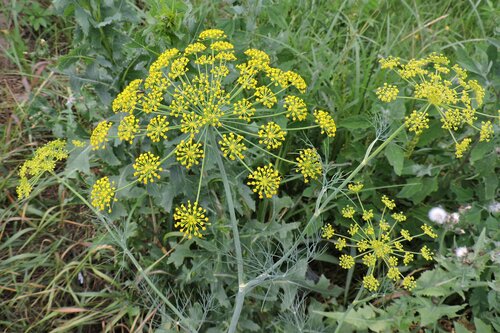
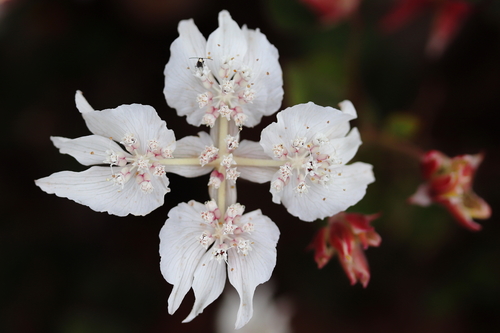
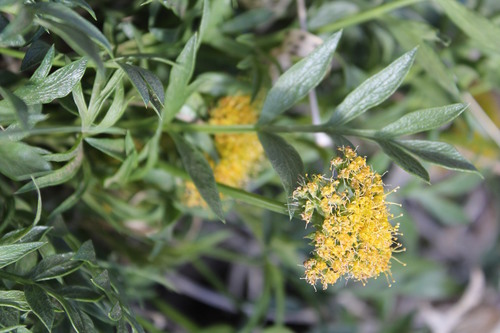
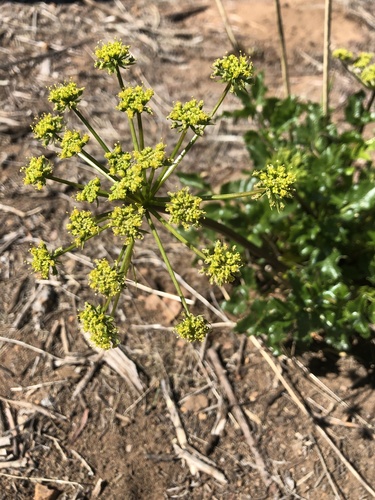
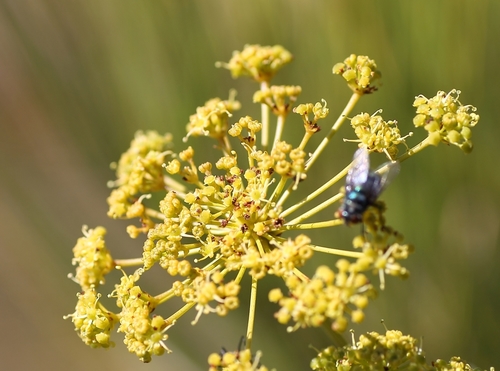
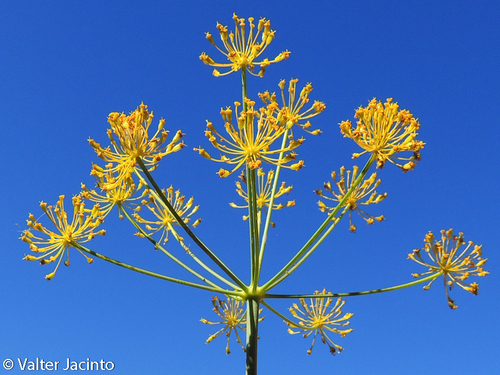
Thapsia villosa L. is a perennial herb that grows 70 to 190 cm (28 to 75 in) tall. It has a robust, smooth tapering stem 5 to 25 mm (0.20 to 0.98 in) in diameter, growing from a thick white root that resembles a carrot or turnip. As its species name suggests, its leaves are hairy. Basal leaves have well-developed hairy sheath-like petioles 20 to 80 mm (0.79 to 3.15 in) wide; these petioles may be whitish, yellowish, green, or rarely purple. Leaf blades are triangular to deltoid in shape, pinnate, and subdivided one to three times. Final leaflets are usually 8 to 32 mm (0.31 to 1.26 in) wide in T. villosa var. villosa, while they are only 1.5 to 3 mm (0.059 to 0.118 in) wide in T. villosa var. dissecta. Leaf margins are revolute (curled), with small tooth-like or triangular serrations each tipped with a small spike. The main leaf rachis (midrib) is densely hairy and light to dark green on its upper side, and smooth and grayish to greenish on its underside. Leaves are largest at the base of the stem, and become progressively smaller moving upward; in the upper stem, leaves are often reduced to just petioles that form sheaths around the stem. Like other species in its genus, the inflorescence of Thapsia villosa is a compound subhemispherical to globose umbel. This umbel is 6 to 12 cm (2.4 to 4.7 in) in diameter, and has 9 to 29 spokes. Bracts are usually absent, though rarely one to three lanceolate bracts 6 to 40 mm (0.24 to 1.57 in) long may be present. The smaller umbellules are hemispherical to globose; bracteoles are also usually absent, though 1 or 2 may rarely occur. Each umbellule holds 18 to 43 flowers, each with five bright yellow elliptical petals. Fruits are oblong, 9 to 15 mm (0.35 to 0.59 in) long and 6 to 11 mm (0.24 to 0.43 in) wide. When mature, they are light to dark brown with four yellowish to brownish wings, a trait characteristic of the genus. The main umbel holds hermaphroditic flowers, which contain both stamens and pistils. Smaller lateral umbels that develop from the sides of the stem usually only contain stamens, and wither quickly. Thapsia villosa is highly morphologically variable. The two accepted varieties, T. villosa var. dissecta and T. villosa var. villosa, are typically distinguished by how many times their leaves subdivide into leaflets. T. villosa var. dissecta has leaves that are deeply subdivided two or three times into narrow, small leaflets, while T. villosa var. villosa leaves are usually only subdivided once or twice. Numerous intermediate forms exist between the two varieties, making them very difficult to distinguish. The diploid chromosome number (2n) of Thapsia villosa is 22, 33, 44, or 66. The native range of Thapsia villosa stretches from southern France and the Iberian Peninsula (Spain, Portugal, and Gibraltar) to northwestern Africa (Morocco, Algeria, and Tunisia), and it has been introduced to Corsica. It grows at altitudes from 0 to 1,800 m (0 to 5,906 ft) above sea level in scrublands, clearings, and near recently disturbed land such as roads or cultivated fields. In its native range, it is frequently confused with the similar-looking giant fennel, Ferula communis; the two species even share common Spanish names like cañaheja. Reports of Thapsia villosa growing in the Balearic Isles are likely the result of confusion with Thapsia gymnesica. Unlike most members of the family Apiaceae, Thapsia villosa flowers early, during May, June, and July. Its flowers are pollinated by a variety of insects. Flowers develop into winged fruits that dry out around August, when most other Apiaceae species are still in bloom. Thapsia villosa is highly poisonous. Skin contact with its roots can cause severe itching and swelling. Medicinal properties of plants in the genus Thapsia were recognized as early as 300 BC. In traditional medicine, roots of Thapsia villosa were used as a purgative and emetic. Resin from this species was used as a vesicant (blister-producing agent) or counterirritant, similarly to resin from Thapsia garganica. In the Segarra region of Spain, this resin is also traditionally used to treat scabies. Poultices made from root bark infused in oil were used as pain relievers and to treat rheumatism, and were also used in Salamanca to treat cracks in horse hooves. These traditional uses are now considered largely ineffective and highly inadvisable, due to the danger posed by the plant's poisons. Along with Thapsia garganica and Thapsia transtagana, Thapsia villosa var. villosa contains C-19 terpenolides with strong SERCA-inhibiting properties in vitro. These compounds are of interest to medical researchers for their potential use in treating neurodegenerative disorders such as Alzheimer's disease and Parkinson's disease. Poison from the roots of Thapsia villosa is traditionally used by fishermen in Catalonia as an ichthyotoxin to stun fish, making them easier to catch. Extracts from the root bark of Thapsia villosa have been used since ancient times as a yellow dye. In the 18th century, yellow dye from the flowers was used to color wool. Thapsia villosa is also grown as an ornamental plant for its bright yellow flowers.