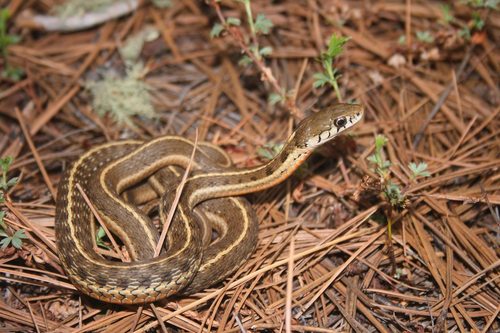
About Thamnophis sirtalis (Linnaeus, 1758)
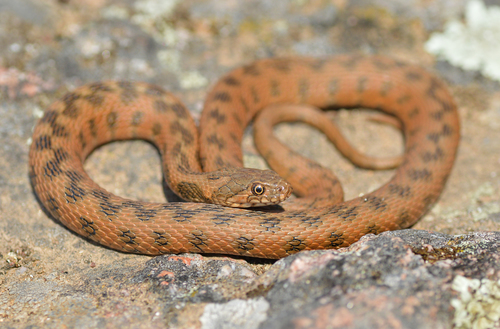
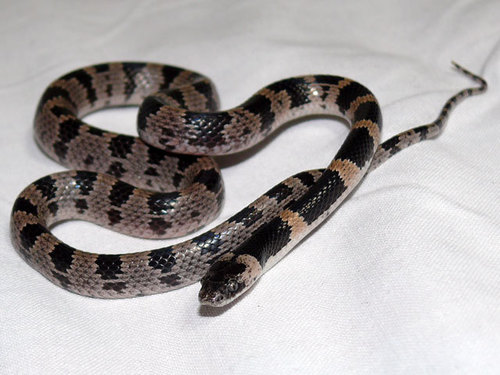
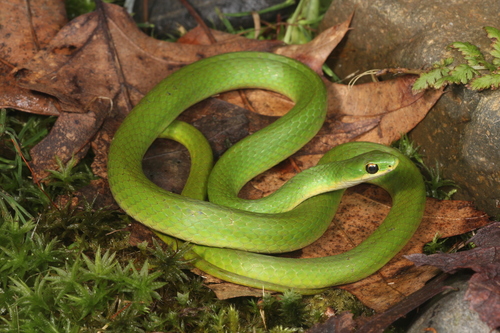
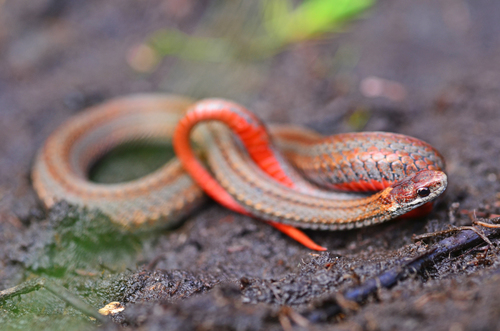
Anatomy and description: Common garter snakes are slender. Few grow longer than around 4 feet (1.2 meters), and most individuals are smaller. Most have longitudinal stripes in many different colors. They display a very wide range of body colors, including green, blue, yellow, gold, red, orange, brown, and black.
Habitat: The common garter snake occupies habitats ranging from forests, fields, and prairies to streams, wetlands, meadows, marshes, and ponds, and it is often found near water. Depending on the subspecies, its range extends from the southernmost tip of Florida in the United States, southward, to the southernmost tip of the Northwest Territories in Canada, northward. It occurs at altitudes from sea level up into mountainous areas.
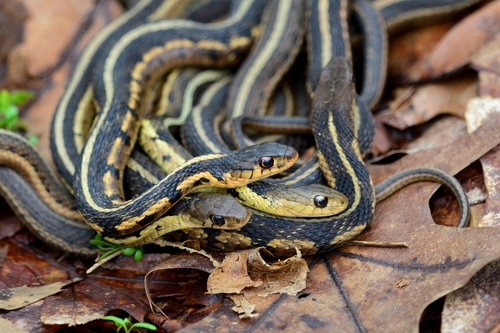
Reproduction: In most common garter snake populations, there are far more males than females. During mating season, this leads to the formation of "mating balls", where one or two females are completely surrounded by ten or more males. Sometimes a male mates with a female before hibernation, and the female stores the male's sperm internally until spring, when she allows her eggs to be fertilized. If the female mates again in spring, the sperm stored from the fall mating degenerates, and the spring sperm fertilize her eggs instead. Females are ovoviviparous, and give birth to 12 to 40 live young between July and October.
Early in the mating season, as snakes emerge from hibernation, males generally leave hibernation first to wait for females to wake. Some males mimic females, leading other rival males away from the hibernation burrow by luring them with a fake female pheromone. After leading rivals away, the mimicking male reverts to his normal male identity and races back to the den, arriving just as females begin to emerge. He is then the first to mate with any available females he can reach. This mimicry also warms the mimicking male, as tricked rival males surround him and give off body heat. This tactic is particularly useful for subspecies living in colder climates, such as the region inhabited by T. s. parietalis, and this type of deceptive mimicry occurs primarily in this subspecies. Studies have found that these deceptive mimicking males mate with significantly more females than males that do not use this mimicry.