About Thamnophis saurita (Linnaeus, 1766)
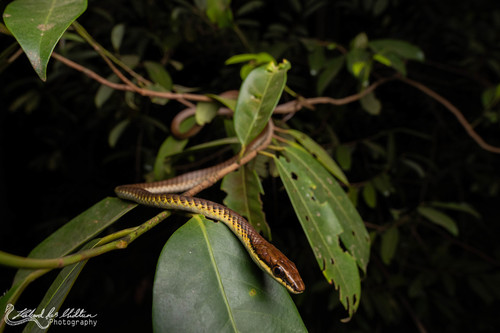
Thamnophis saurita, commonly called the eastern ribbon snake, common ribbon snake, or just ribbon snake, is a common non-venomous garter snake species native to Eastern North America. It belongs to the subfamily Natricinae within the family Colubridae. The species has an average total length (including the tail) of 16 to 35 inches (41 to 89 cm). Its body is dark brown with bright yellow stripes. While the ribbon snake is not sexually dimorphic, females are typically thicker than males. Ribbon snakes are found in wet environments including lakes, streams, ponds, and marshes; they are semi-aquatic and rarely located far from water. They can be seen basking or resting along the edges of ponds, streams, and swamps, as well as in wet woodlands and grasslands. Shallow water is used both as a hunting area and an escape from predators. Ribbon snakes are active from April through October and hibernate in winter; their overwintering sites are usually underground at higher elevations, such as under rock piles. Maturity is generally reached around 3 years of age, with most individuals reaching sexual maturity after two to three years when they become able to breed. After hibernation ends in spring, ribbon snakes begin searching for mates. Once mature, they breed one or two times per year. Ribbon snakes are ovoviviparous, meaning they give birth to live young. Litters of 4 to 27 live young are typically born in summer.