About Thamnolaea cinnamomeiventris (Lafresnaye, 1836)
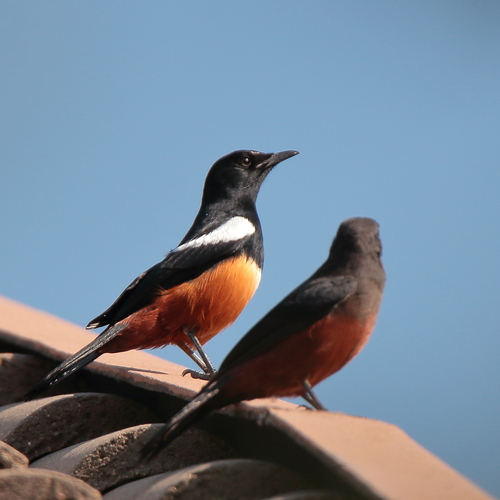
The mocking cliff chat, scientifically named Thamnolaea cinnamomeiventris (Lafresnaye, 1836), is a large chat species with clearly distinct colouration. Males have glossy black plumage paired with chestnut bellies, vents, rumps, and white shoulder patches; the size of these shoulder patches differs geographically across populations. Females are dark grey, with chestnut colouring on their lower breasts, bellies, and vents. This species measures 19–21 cm in length and weighs 41–51 grams.
In terms of distribution and habitat, the mocking cliff chat is found in a continuous narrow band stretching from northern central Ethiopia, through east Africa, down to Zimbabwe, south-eastern Botswana, southern Mozambique, and eastern South Africa, reaching as far south as the far eastern part of Western Cape province. Most individuals are non-migratory residents, but populations in the southern portion of the species' range typically move to lower altitudes during winter. It lives in rocky, boulder-strewn areas, well-wooded rocky ravines, cliffs, gullies, boulder-strewn hillsides, and valley-bottom watercourses with scattered rocks.
For feeding ecology, the mocking cliff chat is primarily insectivorous, but it also consumes fruit and feeds on nectar from aloes, specifically the Krantz aloe, Aloe arborescens. Its main foraging method is to pounce on prey on the ground from an elevated perch, though it also gleans food from branches and foliage. These birds habitually wag their tails, slowly lifting their tails above their backs and fanning them out as they do so.