About Thalictrum clavatum DC.
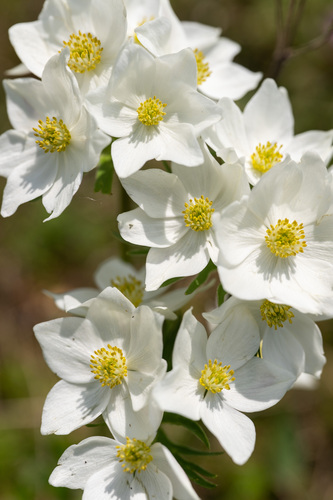
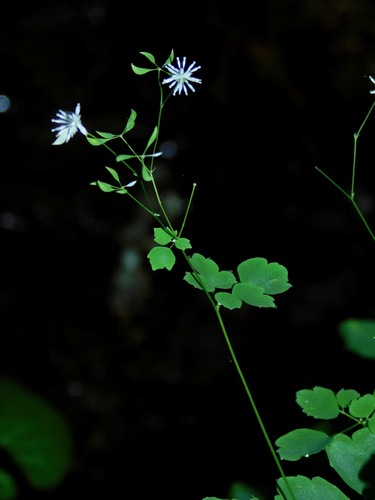
Thalictrum clavatum DC. flowers have no petals, and typically bear 4 to 5 white obovate-spatulate caducous sepals that measure 2.5 to 4.0 mm and detach once the plant flowers. Flowers are cosexual, containing both male and female reproductive organs. The male reproductive structures include numerous petaloid, flattened white filaments 2.5–4.0 mm long, and anthers 0.3–0.5 mm long. The female reproductive structures include a superior ovary and several white stigmas, with basal marginal placentation. Individual flowers are radially symmetrical (actinomorphic), arranged in a pom-pom shape, and measure roughly 1/3 of an inch wide. The overall inflorescence is a panicle or nearly corymb. The pedicel is slender and bears few to no leaves. Proximal cauline leaves, located toward the base of the plant, are petiolate, with 2 or 3 degrees of compounding. Distal cauline leaves are sessile, with 1 or 2 degrees of compounding. Both proximal and distal cauline leaves are bi-ternately compound, and arranged in an alternate configuration along the stem. Leaflets are obovate with apically lobed tips, and measure roughly 10–30 mm wide. Leaflets have no fragrance, their undersurface is glaucous (waxy), leaves are deciduous, broadleaf with ternate venation and crenate margins. The roots of Thalictrum clavatum are few in number, black in color, and slightly tuberous. The fruit of this species is an achene: a dry, one-seeded fruit that does not open when ripe. Plants usually produce 3 to 8 achenes arranged in a spreading pattern. Each achene has an elongated stipe (stalk) that measures 1.0–3.0 mm. Achenes are flat and sickle-shaped, with veining along their sides. The stem of Thalictrum clavatum is slender, smooth, green, erect, glabrous (hairless), and grows 15 to 60 cm tall. This species is endemic to the South and Central Appalachian regions of the United States, occurring in the states of Virginia, West Virginia, North Carolina, South Carolina, Georgia, Kentucky, Tennessee, and Alabama. It is abundant in Appalachian mountain regions, and has also been rarely reported from low elevations in the Western Piedmont Foothills. It is typically found in dense forests near cold water sources, including wooded seepages, streamsides, spray cliffs at waterfalls, and brookbanks. It is commonly observed in groves, stands, seeps, screes, and outcrops, as well as other wooded and riparian environments, and less frequently occurs in rich cove forests. It can be found at elevations between 0 and 700 feet, and is most often found at 500 feet. It is labeled L48 N by the United States Department of Agriculture Natural Resource Conservation Service, indicating it is a native species of the continental United States. It has a heliophily value of 3 on the Heliophyte Index, which measures a species' sunlight requirement for growth and reproductive success; a value of 3 indicates it is adapted to or tolerant of shaded environments. It is categorized as a Facultative Wetland (FACW) species on the National Wetland Plant List, meaning it is likely to occur in wetland environments, and acts as an indicator of wetland biomes, particularly in the Eastern Mountains and Piedmont regions, and areas of the Atlantic and Gulf Coastal Plains. Thalictrum clavatum is most commonly observed from early April to mid-July, though rare earlier sightings have been recorded in early August. It produces white flowers during spring and summer, between May and July, blooming after the spring wildflowers of rich cove forests have already flowered. Achene fruits develop after flowering.