About Thalassodes immissaria Walker, 1861
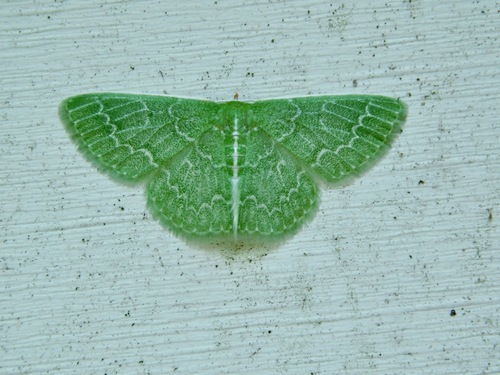
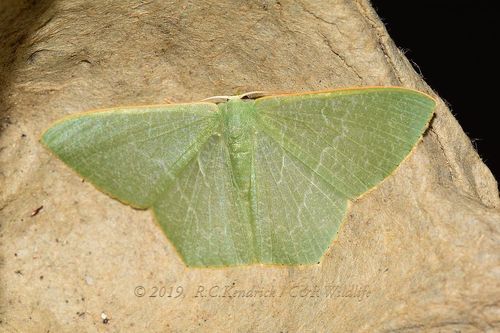
Thalassodes immissaria is a moth in the family Geometridae, first described by Francis Walker in 1861. It occurs in the Oriental tropics, including China, India, Myanmar, Sri Lanka, Hong Kong, Japan, Borneo, Vietnam, Sumatra, Sulawesi, and the Ryukyu Islands. Populations from the Ryukyu Islands were long classified as the subspecies Thalassodes immissaria intaminata Inoue, 1971. In 2005, this subspecies was elevated to full separate species status; the two can be told apart by careful examination of male genitalia. This species is a green moth with faint white lines, and has a very narrow yellowish line along the wing borders. Males have plumose, feather-like antennae, while females have filiform, thread-like antennae. Thalassodes immissaria looks very similar to other species in the same genus, so reliable identification requires examination of genitalia. In male Thalassodes immissaria, the genitalia have a long, tongue-like valva basal process and a tongue-like harpe. The caterpillars of this moth feed on Mangifera indica, Lagerstroemia, Nephelium, Eucalyptus camaldulensis, Dimocarpus longan, and Litchi chinensis.