About Thaduka multicaudata Moore, 1878
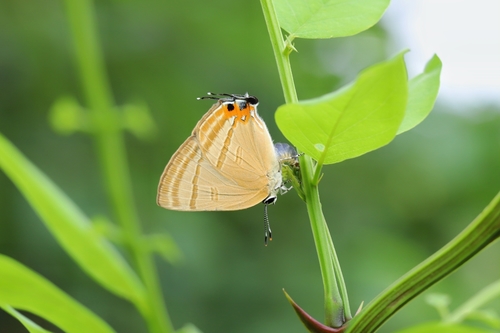
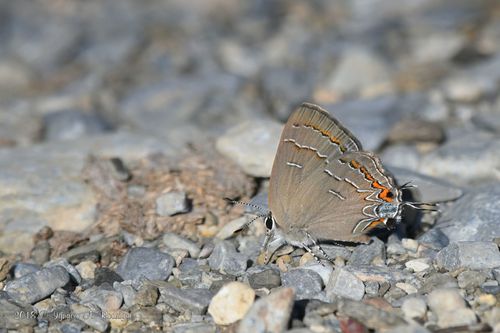
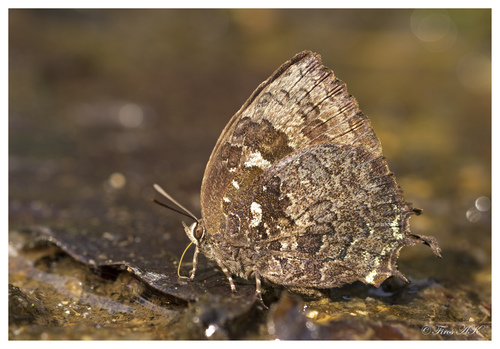
This species is Thaduka multicaudata Moore, 1878. Males have a black upperside, with a basal area of smalt-blue or silvery-blue. The rest of the wings are blue, with very broad black borders that cover all areas except the basal, discoidal, and sub-median regions. Cilia and tails are also black. The underside is dark vinous-brown. On the forewing, the outer half and lower portions are paler. There are three blue spots in the basal half of the cell, and a larger blue spot at the end of the cell that contains a brown dot inside it. A discal band of six separate square spots runs from the costa to vein 2: the first two are outwardly oblique, the third sits outside these first two, and the next three are positioned a little inward from each preceding spot. A sub-marginal series of acutely angled marks is also present on the forewing. The hindwing is generally darker than the forewing. It has three outwardly curved, irregular bands of separated spots with pale edges, positioned ante-medially, medially, and discally; these bands are often very indistinct. The anal area has some bronzy or bluish scales, and a few similar scales are present near the base, and sometimes on other portions of the wing. Females match males in appearance on both the upperside and underside, but on the upperside, the blue area is generally paler and less silvery. On the underside, the wings are not quite as dark, especially the lower portion of the forewing. Markings are more distinct in females, and blue scalings on the hindwing are more numerous. Antennae are black. Palpi are black on the upper side, while the two basal joints are grey on the underside. The head and body are black above, and brown beneath.