About Teucrium trifidum Retz.
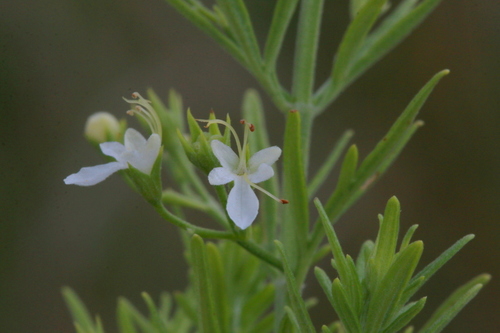
Teucrium trifidum Retz. is an erect, softly woody undershrub that grows 30 to 110 cm (0.98 to 3.61 ft) tall, branching freely from its base. Its stems are slender and wand-like, woody near the base and herbaceous above, covered by a thin layer of short greyish hairs. Leaves of this species are variable in shape. They are most often deeply divided into three, or sometimes up to five, narrow lobes, and measure 2 to 6 cm (0.79 to 2.36 in) long. The foliage is thinly hairy to almost silvery; individual lobes are linear to lance-shaped, 1 to 3.5 cm (0.39 to 1.38 in) long and 3 to 8 mm (0.12 to 0.31 in) wide, and may have additional shallow lobes or teeth. The inflorescence is a leafy, branched panicle that occupies the upper third of the stem. Flowers are usually produced in small clusters of three to seven on stalks 5 to 20 mm (0.20 to 0.79 in) long, which are typically longer than the spaces between the stem's leaves. The calyx is 2.5 to 4.0 mm (0.098 to 0.157 in) long. The corolla is 5 to 6 mm (0.20 to 0.24 in) long, white, with an obovate lower lip and oblong to rounded upper and side lobes. Anthers extend outward 6 to 8 mm (0.24 to 0.31 in) past the corolla. All three Teucrium species found in South Africa have similar-looking white flowers, so identification must rely on vegetative and inflorescence characteristics. Teucrium trifidum overlaps in range with Teucrium africanum in the Eastern Cape, from around Makhanda to Komani. Teucrium trifidum typically grows over 30 cm (12 in) tall, while Teucrium africanum usually grows under 30 cm tall. Teucrium africanum also usually produces solitary flowers on short stalks. Teucrium trifidum also overlaps in range with Teucrium kraussii in the Eastern Cape, around Komga. Even when leaf shape is similar between the two species, Teucrium trifidum has smaller, greyer leaves than Teucrium kraussii. This species is common in Gauteng and North West provinces of South Africa, briefly extending across the border into Botswana, and south into the central Free State, Lesotho, and parts of the Northern Cape. It also occurs in eastern Mpumalanga, northern KwaZulu-Natal, and the Eastern Cape, reaching as far south as Humansdorp. It typically grows in dry woodland, especially in overgrazed or disturbed areas.