About Teucrium canadense L.
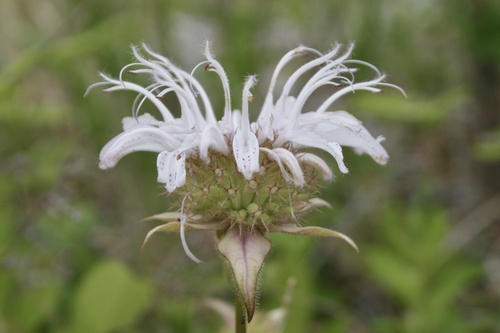
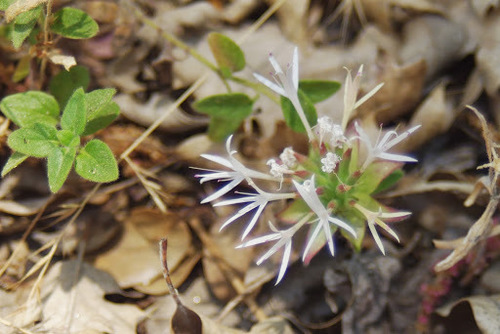
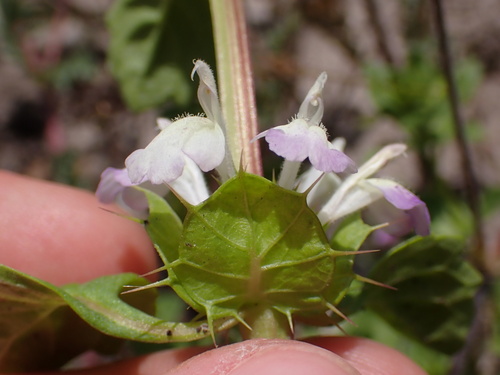
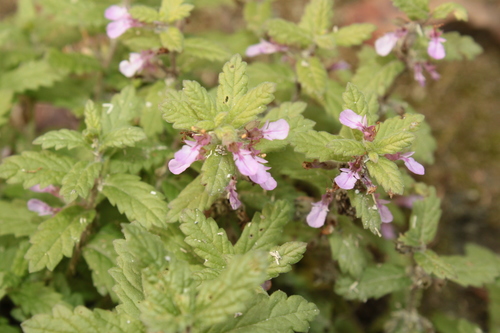
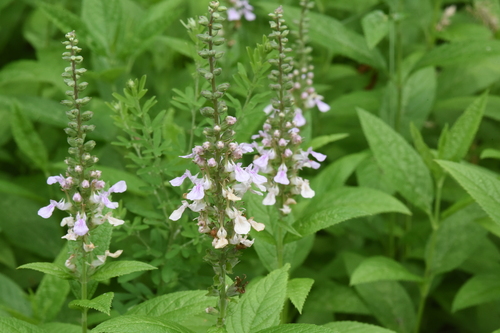
American germander, scientifically named Teucrium canadense L., is a robust perennial plant with a fibrous root system. It forms clumps that can reach up to 3 feet (90 cm) in height. Its upright stems are squarish, with small side branches, and produce rhizomes at the base. The leaves are arranged oppositely along the stem: lower leaves have stems, while upper leaves do not. Leaves are ovate or lanceolate, with deep veins and coarse teeth, and can grow up to 5 inches (13 cm) long and 2.5 inches (6 cm) wide. The terminal inflorescence is a raceme up to 8 inches (20 cm) long, holding numerous whitish or pale lilac lipped flowers that have large shelf-like lower lips. The plant blooms starting around mid-June for about one month, with flowers opening from the bottom of the raceme upward. The flowers have no scent. Its fruits contain four roundish, yellowish brown seeds. This species is native to North America. Its range covers all 48 contiguous United States, and it is also found across most of Canada. It is a common plant that grows in moist grassland, forest edges, thickets, river verges, and marsh edges. It also grows on wasteland, in poorly-drained areas, and beside roadside ditches, and can be somewhat aggressive. The flowers of American germander are adapted for pollination by long-tongued insects, with the lower lip acting as a landing platform for visiting insects. Known pollinators include bumblebees, honey bees, digger bees, cuckoo bees, and megachilid bees. The flowers are also visited by flies and butterflies, and occasionally by hummingbird moths and hummingbirds. Grazing animals find the foliage unappealing due to its bitter taste. American germander contains multiple chemicals with pharmacological properties, including flavonoids, diterpenoids, tannins, bitter aromatics, volatile oils, and glycosides such as saponins. The earliest recorded use of this plant is by Native Americans, who ground the leaves to make a herbal tea used as a diuretic and to promote sweating. The green parts of the plant are also used as an antiseptic wound dressing, and made into a tincture for gargling.