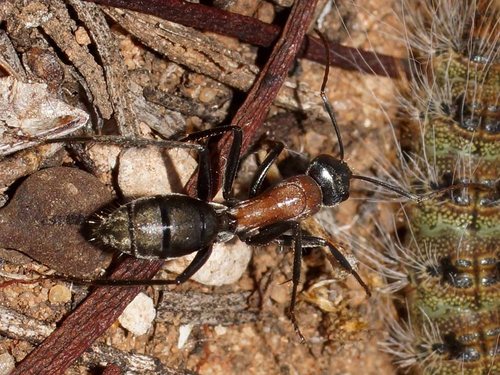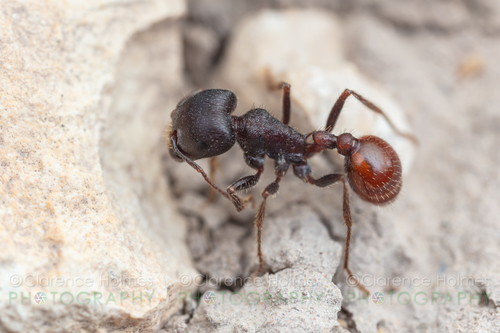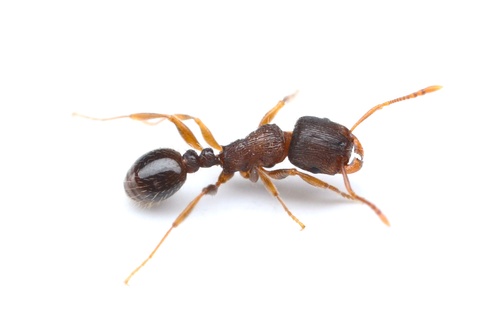
About Tetramorium immigrans Santschi, 1927
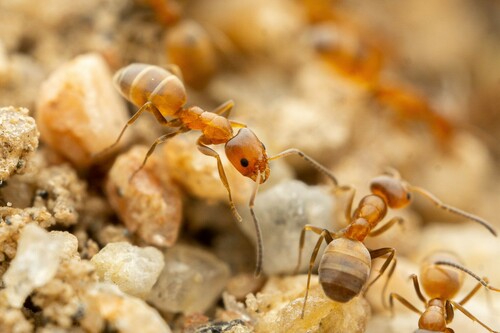
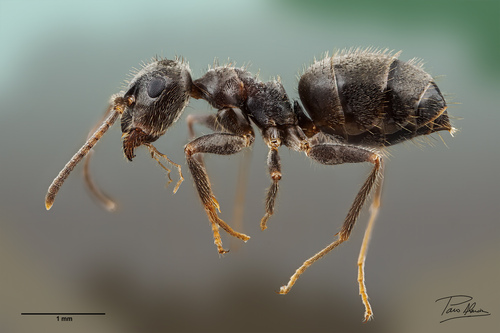
This species is commonly known as the pavement ant. Individual pavement ants range in color from dark brown to blackish, and reach 2.5–4 millimeters (0.10–0.16 in) in length. A mature colony contains workers, alates, male drones, and a single queen. Worker pavement ants have a small stinger that can cause mild discomfort in humans but is not considered dangerous. Alates, which are virgin new queens and male drones, have wings and are at least twice as large as worker ants. Nuptial mating flights for this species take place in spring and summer, when unmated queens and drones leave the natal nest to find mates. The only role of a drone is to mate with a virgin queen. After mating, the newly fertilized dealate queen sheds her wings, locates a suitable nesting site, and digs a founding chamber called a claustral cell. The queen raises the colony's first generation of offspring on her own, until workers are old enough to forage for food. During this founding period, she survives by metabolizing protein from her now-unused flight muscles. After eggs hatch and worker ants develop, young workers spend approximately two to three months tending to the colony's queen, and continue assisting with colony tasks until they reach one month of age. Older workers take on foraging for food and defending the colony. Pavement ants are generalist feeders that eat almost any available food, including other insects, seeds, honeydew, honey, bread, meats, nuts, ice cream, and cheese. While pavement ants do not usually nest inside buildings, they may enter homes to access exposed food and become a minor nuisance for humans. They are also known predators of codling moth larvae. Tetramorium immigrans builds shallow to moderately deep nests in pavement cracks, compacted soil, and other disturbed urban substrates. Multiple surveys have found that most nests occupy a surface area between 1.2-4.8 m², with workers defending a surrounding territory of approximately 43 m², though some colonies fall outside this size range. Nests have an internal structure of many interconnected chambers and galleries. Most of a nest's total volume is located 30-50 cm below the ground surface, with tunnels measuring 6-9 mm in diameter. In certain soil types, vertical shafts and isolated chambers can extend as deep as 60-90 cm below the surface. Nests most often have multiple entrance openings marked by crater-like mounds of excavated soil; these mounds are especially visible during the warmer season when foraging activity increases. Pavement ants prefer to inhabit areas with little to no vegetation. They are one of the few ant species that see population growth after extensive urban development. Studies of ant diversity in New York City found Tetramorium immigrans to be the most abundant ant species, making up more than 93% of the ant population in surveyed areas. This species is currently established in approximately 39 mainland U.S. states and 3 Canadian provinces, and its range across North America expands steadily each year. In urban areas, altered climate conditions help Tetramorium immigrans expand its range. Urban heat island effects trap heat in cities, allowing the species to survive and have higher fitness in areas that would otherwise be too cold, increasing the area it can successfully inhabit. Genetic analysis has identified distinct genetic sub-clusters of Tetramorium immigrans in geographically distant locations. Surprisingly, these geographically separated sub-clusters are genetically very similar, despite expectations that they would be genetically distinct. This pattern suggests accidental human-mediated dispersal has helped the species expand its range. Urbanization increases contact between different Tetramorium species, and studies have recorded hybridization between Tetramorium immigrans and Tetramorium caespitum. Urban areas act as ecological contact zones by removing natural geographic barriers and concentrating species in areas where they would not naturally encounter each other. Human disturbance alters evolutionary landscapes, creating new selective pressures and more opportunities for genetic exchange between species. Increased gene flow introduces new genetic alleles that help Tetramorium immigrans adapt to urban environments. Tetramorium immigrans populations in North America have exceptionally low genetic diversity, leading researchers to hypothesize that all North American pavement ants descend from a single small founding lineage around two centuries ago. No inbreeding has been detected in the species, which is an unusual trait for an invasive ant species.