About Tetragonotheca texana (A.Gray) Engelm. & A.Gray
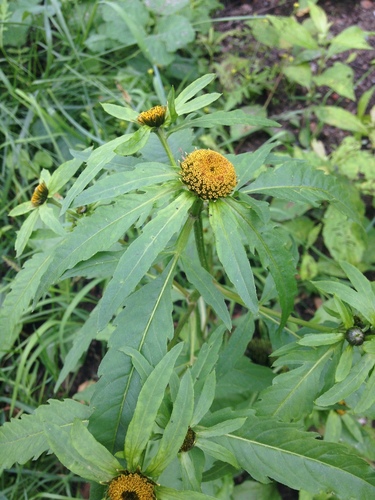
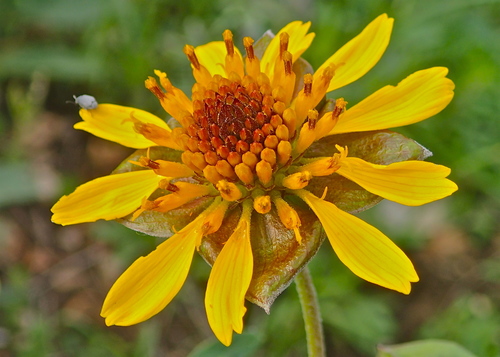
Scientific name: Tetragonotheca texana (A.Gray) Engelm. & A.Gray. Like all four species in the genus Tetragonotheca, this striking wildflower has an unusual feature: at the base of every flowering head, four of the head’s several involucral bracts are fused together to form an oversized, square collar-like structure. The following features further distinguish squarebud daisy from similar related species. Each disc floret is accompanied by a conspicuous, sharp-tipped, scale-like bract called a palea. Disc florets grow from a conical receptacle platform. The petal-like ray florets have flat corollas, number between 8 and 13, and reach up to 18 millimeters (around ⅞ inch) in length. Inside each flowering head, at the base of the corolla of every small floret, the pappus is formed by zero to ten sharply pointed scales. Squarebud daisy also has distinct vegetative features that identify the species. The plant grows to a maximum height of about 1.2 meters (4 feet). Its leaves are arranged along the stem, rather than growing only at the plant’s base. Leaves are moderately to narrowly egg-shaped, and grow up to 7 centimeters long and 3 centimeters wide (around 2 ¾ by 1 ⅕ inches). Leaf margins range from lacking notable indentations or teeth to being fairly deeply cut or irregularly pinnatifid. Stems are either hairless or only sparsely covered with short, matted, woolly hairs. Squarebud daisy is endemic to southwestern Texas in the United States, and the northeastern Mexican states of Coahuila, Nuevo León, and Tamaulipas. It grows in well-drained, dry, sandy, rocky soil over limestone, and is often found growing alongside Mesquite.