About Tetragonia tetragonoides (Pall.) Kuntze
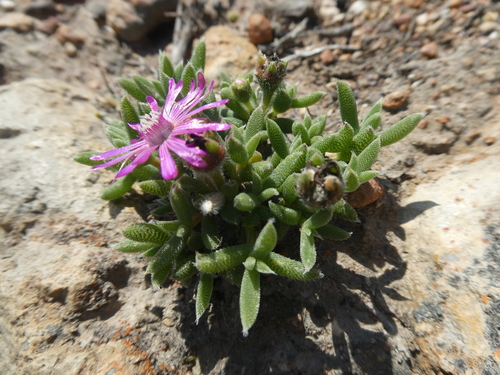
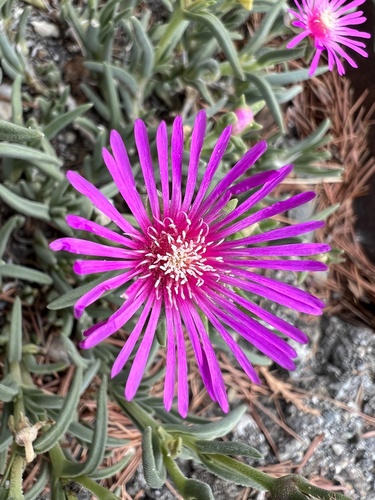
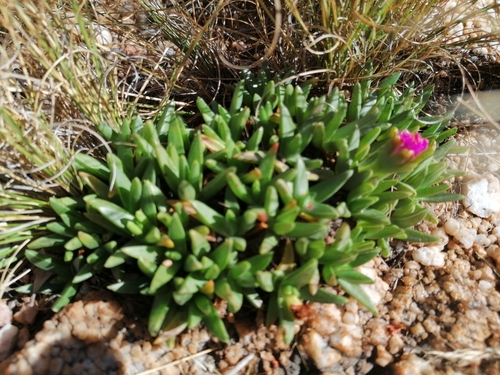
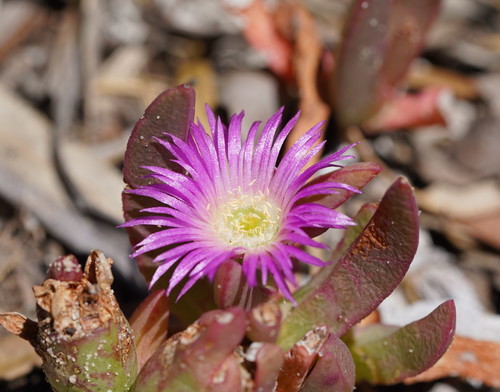
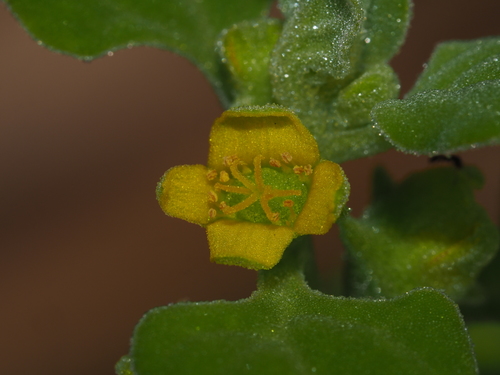
This species is scientifically named Tetragonia tetragonoides (Pall.) Kuntze. The plant has a trailing growth habit, forming a thick carpet along the ground, climbing through other vegetation, or hanging downward. Young plants can grow erect. Its leaves measure 3–15 cm (1.2–5.9 in) long, are triangular in shape, bright green, and thick. Both the upper and lower surfaces of the leaves are covered in tiny papillae that resemble water droplets. The plant produces yellow flowers, and its fruits are small, hard capsules that each contain 4–10 horned seeds. Sphaeraphides are present in at least the leaves, calyx, and ovary.
It is cultivated for its edible leaves, and can be grown as food, or used as an ornamental ground cover plant. It can grow as either an annual or perennial. As suggested by some of its common names, it has a similar flavor and texture to spinach, and is cooked the same way as spinach. Like spinach, it contains oxalates; its medium to low oxalate levels can be removed by blanching the leaves in hot water for one minute, then rinsing them in cold water before further cooking. It grows well in hot weather and is classified as an heirloom vegetable. Very few insects eat this plant, and even slugs and snails do not appear to feed on it. Its thick, irregularly shaped seeds should be planted just after the last spring frost. Before planting, seeds should be soaked for 12 hours in cold water, or 3 hours in warm water. Seeds should be planted 5–10 mm (0.2–0.4 in) deep, spaced 15–30 cm (5.9–11.8 in) apart. Seedlings emerge 10–20 days after planting, and the plant will continue producing leafy greens through the summer. Mature plants will self-seed, and seeds can overwinter successfully up to USDA zone 5.
As a food plant, it was rarely used as a leaf vegetable by Indigenous peoples before it was first documented by Captain Cook. Cook's crew immediately picked, cooked, and pickled the plant to help prevent and treat scurvy, and carried it aboard the Endeavour. It spread after explorer and botanist Joseph Banks brought seeds back to Kew Gardens in the latter half of the 18th century. For two centuries, T. tetragonioides was the only cultivated vegetable that originated from Australia and New Zealand. There is some evidence that Māori ate this plant (called kōkihi) somewhat more regularly. According to Murdoch Riley, to offset the bitterness of older leaves, Māori boiled the herb alongside the roots of pōhue, a convolvulus now classified in the genus Calystegia within the family Convolvulaceae. The growing tips of the plant can be pinched off and eaten either raw or cooked.