About Tetragnatha versicolor Walckenaer, 1841
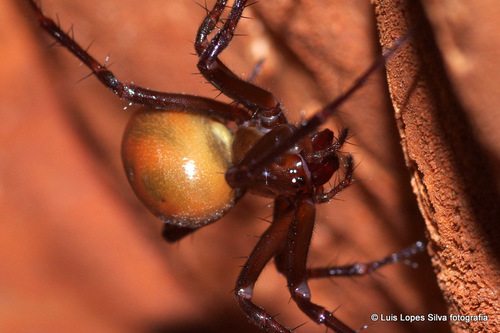
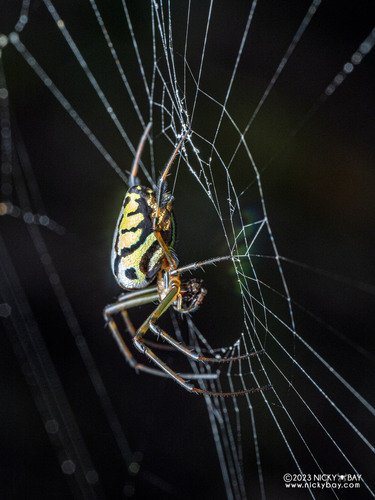
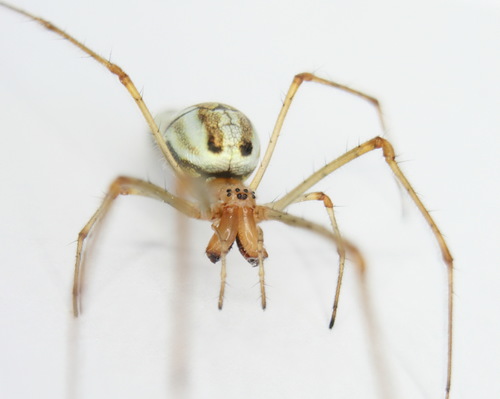
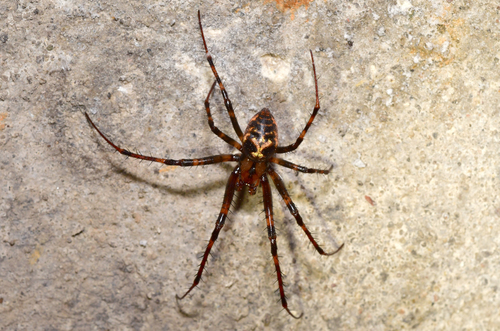
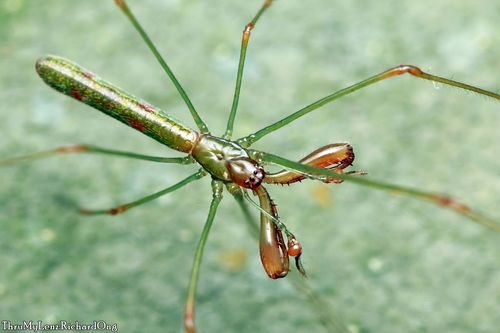
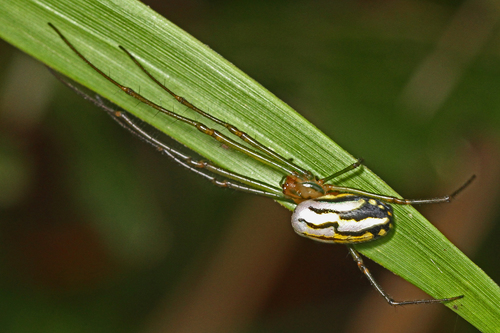
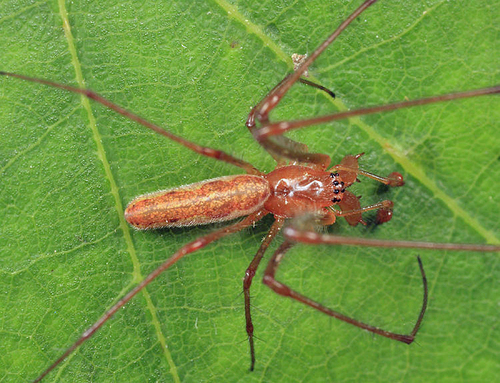
Tetragnatha versicolor is generally a very small spider, with males slightly smaller than females. Males average around 5 mm in length and 1.3 mm in width, while females average around 6.5 mm in length and 1.5 mm in width. The male carapace is typically dark yellow or pale orange, with markings that radiate dorsally. In males, the lateral eyes are closer together than the median eyes, and the distance between median and lateral eyes is rarely equal. The legs match the carapace in color, being dark yellow or pale orange, while the abdomen is silver along its dorsal sides. The male conductor has a thick, rounded tip, and a small point near the base of the structure. Females share the same coloration patterns and eye spacing as males, but have different reproductive structures. The female epigynum is short, broad, and concave, and is located on the posterior section. The spermatheca has an anterior end and a posterior end, and appears large and bulbous. T. versicolor can be found across most regions of North America. In the United States, it is heavily concentrated in the northeast and the west coast, spanning from California to Washington. Sightings have also been recorded in Alaska. The species has been documented throughout all of Canada, and very rarely in Mexico, Central America, and Cuba. T. versicolor is a habitat generalist, meaning it primarily responds to spatial cues and dispersal processes, rather than environmental processes or cues from other individuals. Unlike its close relatives T. viridis, T. straminea, and T. elongata, it can live in areas with a wide range of elevations and vegetation types. While it can be found in habitats such as wetlands, spruce forests, red oak forests, and grasslands, T. versicolor is typically found further from water than other Tetragnatha species. Trees and shrubs are the common natural habitat for these spiders. When present in marshy areas, T. versicolor will usually stay near herbaceous vegetation. Egg sacs of T. versicolor are laid in May, June, and July. Spiders can mate multiple times over a single lifespan. Each egg sac is around 5–6 mm in diameter, and is greenish or whitish in color. A single egg sac can hold up to 103 eggs, each around 0.66 mm in diameter. Mature individuals can be found from April to September. It is unclear how long T. versicolor lives, but it is speculated that they can live at least one year. After spiderlings hatch, they molt several times before reaching maturity.