About Tetragnatha squamata Karsch, 1879
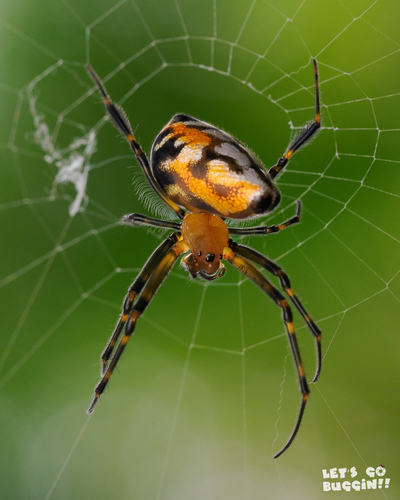
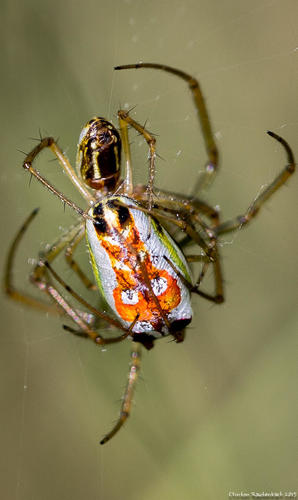
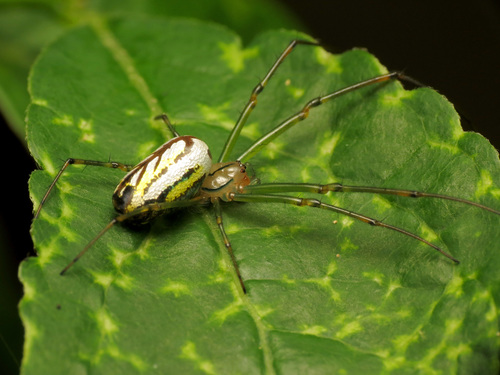
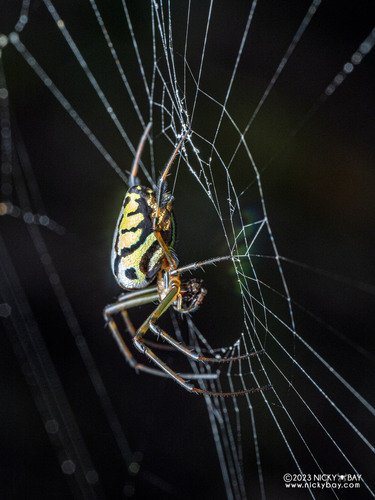
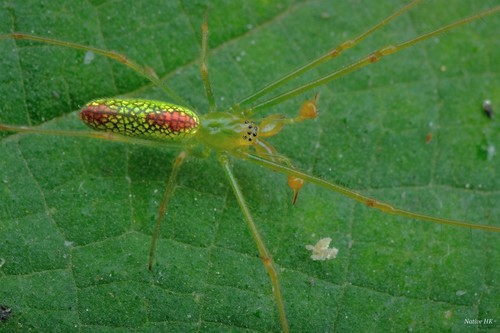
Tetragnatha squamata Karsch, 1879 is a medium-sized long-jawed orb weaver that shows clear sexual dimorphism. Females of this species have a body length of 5 to 8 mm, while males are slightly smaller, reaching 4 to 6 mm in body length. The cephalothorax and appendages are uniformly brownish-yellow. Its elongated opisthosoma is covered in large silvery scales, which form a distinctive brown net-like reticulated pattern. In most specimens, a broad brown band runs transversely across the dorsal surface from front to back, and continues along the sides of the abdomen. The ventral surface located between the vulva and mammillae has very small silvery scales, with glossy brown coloration that forms a longitudinal rhombic band. Female individuals have simple chelicerae that do not develop external teeth, and their vulva is not fully formed in immature specimens. In mature males, the chelicerae are short and oval-shaped. A long, forward-projecting tooth sits near the middle of the dorsal surface, and the tip holds two small teeth located above the insertion point of the cheliceral claw. Below these teeth, the anterior end extends into a bright yellow, elongated tooth-like process. The cheliceral claw is wavy and curved. The inner margin of the chelicerae has seven teeth on its upper side, and one larger tooth on its lower side. The male pedipalp has a distinct modified structure: it has a spoon-shaped, hollow, narrow secondary vessel that extends past the densely hairy, bulbous primary vessel, which has a pointed tip. This species has been recorded in India, China, Taiwan, Russia (Far East), South Korea, and Japan, and is widely distributed across rice-growing regions of East and South Asia. T. squamata is commonly found in agricultural environments, especially in rice paddies and other wetland habitats. Adult individuals are active from spring through summer, and are often encountered on vegetation growing near water sources.