About Tetragnatha extensa (Linnaeus, 1758)
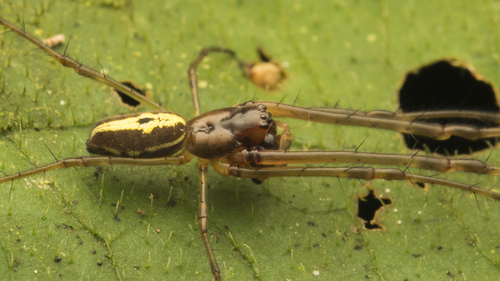
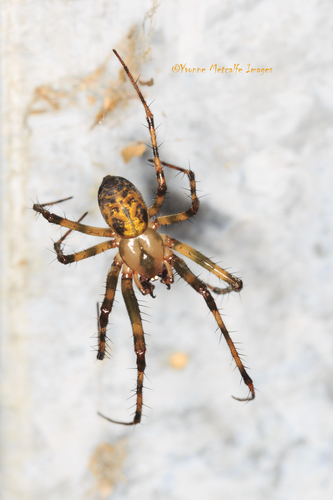
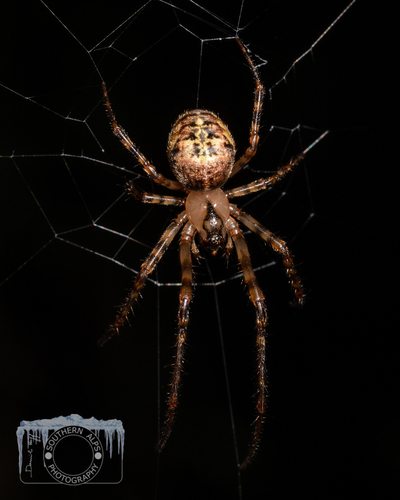
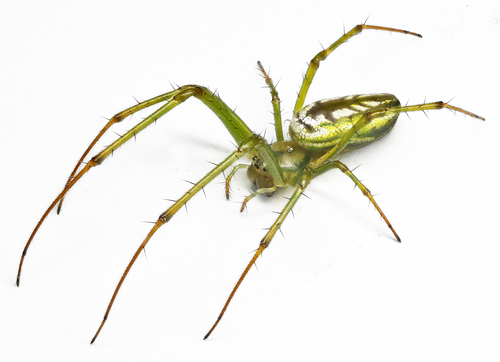
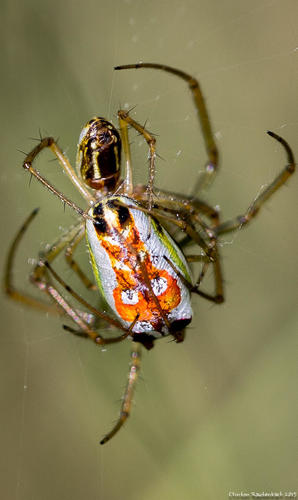
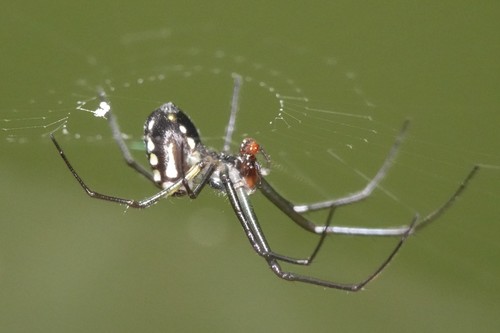
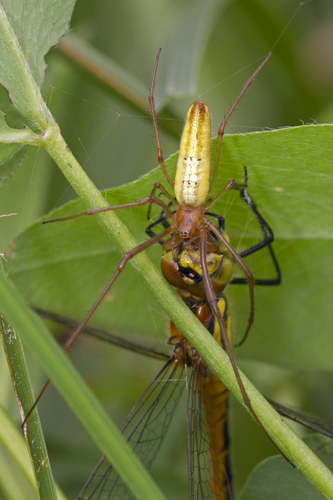
This species, Tetragnatha extensa, has an elongated, cream-coloured body, with males smaller than females: males reach approximately 9 mm (0.35 in) in body length, while females reach around 11 mm (0.43 in). It has four pairs of very long, dark yellow legs. Its carapace measures 1.8–2.6 mm long and 1.1–1.7 mm wide, and is orange or dark yellow. Overall body colouring is quite variable, ranging from creamy-yellow to green. On the underside, there is a thick black central band, with a silvery band on each side. Tetragnatha extensa can be distinguished from other species in the genus Tetragnatha by the small curved tip of the male’s conductor, a structure on the pedipalp, and the specific shape of the female’s spermatheca.
Tetragnatha extensa has a wide distribution across the Holarctic, the Northern Hemisphere. In North America, it occurs from Alaska to Newfoundland, with its range extending south to Washington, Colorado and Pennsylvania. It has been recorded at the tree line in the Rocky Mountains, showing it occupies a broad ecological range. In Europe, it is found in coastal vegetation. It occurs throughout the United Kingdom, where it is the most common species of Tetragnatha, and one of the most common spiders overall. It is also found in Madeira.
In terms of ecology and behaviour, Tetragnatha extensa lives on low-growing vegetation, most often in damp areas. It feeds on insects including mosquitoes, midges and moths, which it captures in a loosely built web. When disturbed, it sits along a plant stem, grass blade, or the central vein of a leaf, with its four front legs extended forward and four back legs extended backward to camouflage itself. This spider can walk on the surface of water, and can move faster across water than it can on land.
For its life cycle, adults are active between May and September in the United Kingdom, and between May and July in Alaska. Courtship behaviour is minimal; during mating, the male and female lock jaws, which may stop the female from eating the male before mating completes. The species produces globular egg sacs covered in grey tufted silk that resemble a bird dropping, and these egg sacs are pressed against plant stems. This species overwinters as early-instar spiderlings.