About Tetradymia canescens DC.
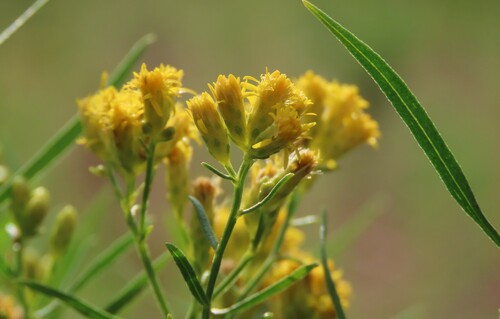
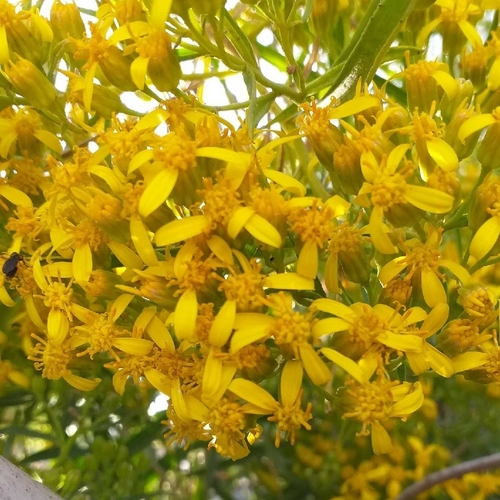
Tetradymia canescens DC. is a bushy shrub 10 to 80 cm (4 to 31 in) tall, with multibranched woody or semi-woody stems that grow from taproots. The plant is covered in woolly fibers, with hairless strips occurring at intervals along its branches. It does not have spines. Its leaves are lance-shaped, no more than 4 cm (1.6 in) long, and have a woolly or silver-haired texture. Longer-lived leaves are arranged alternately along the stem, while smaller, shorter-lived leaves grow in clusters near the axils of the primary leaves. The inflorescence usually holds three to six flower heads, each enclosed by four thick phyllaries covered in white woolly hairs. Each flower head contains four tubular flowers that range in color from pale to bright yellow, and each flower measures 7 to 15 mm (0.3 to 0.6 in) long. Flowering occurs from May through October. The fruit is an achene 7 to 15 mm (0.3 to 0.6 in) long, including its long pappus of bristles. This shrub is resistant to wildfire; it resprouts vigorously and produces more herbage and more seeds in the seasons following a fire. Fire suppression efforts reduce this shrub's abundance, while frequent wildfires increase its abundance. The shrub contains furanoeremophilanes that are toxic to sheep, causing photosensitivity, poor wool quality, abortion, and death. Toxic exposure also causes a head swelling condition called bighead disease. Native American groups used this plant for a variety of medicinal purposes, including as protection from ghosts and witches. The range of Tetradymia argyraea, a related species, lies primarily east of the Cascade Range and Sierra Nevada, extending from British Columbia to California. It reaches eastward to southwest Montana, Wyoming, western Colorado, and northwest New Mexico, where it grows in sagebrush scrub, woodlands, forests, scrubby open plains, and other types of habitat. It grows across a wide elevation range from near sea level to 3,400 m (11,000 ft), but favors elevations between 1,500 and 2,700 metres (5,000 and 9,000 ft).