About Tetraclinis articulata (Vahl) Mast.
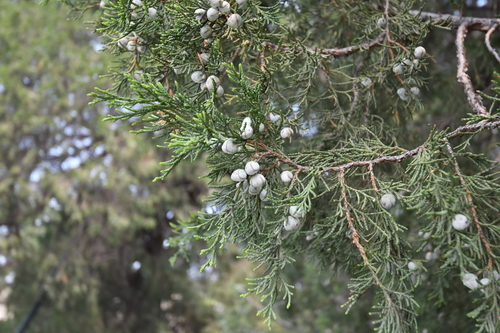
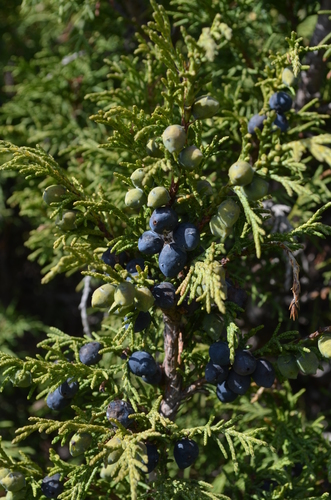
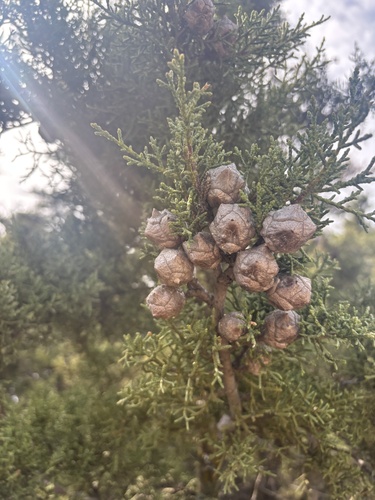
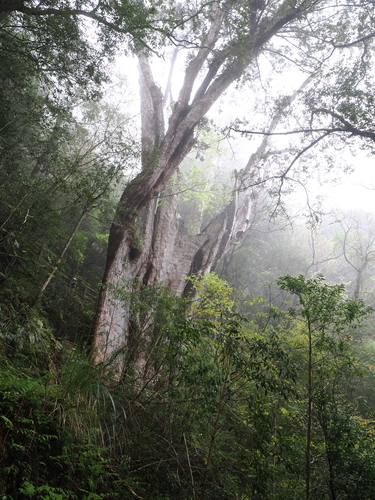
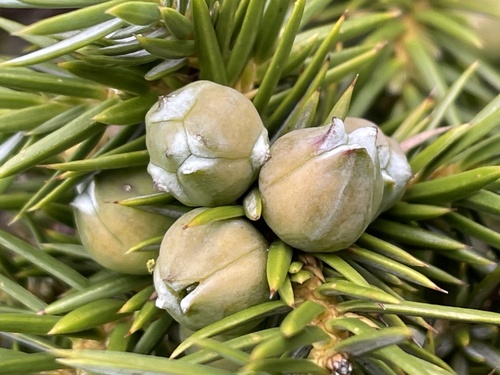
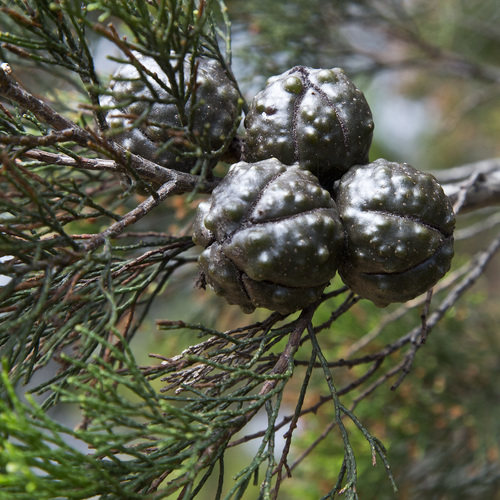
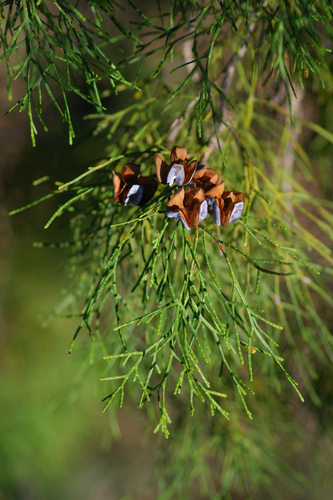
Tetraclinis articulata (Vahl) Mast. is a small, slow-growing tree, reaching 6–15 m in height, and rarely up to 20 m. It typically reaches 0.5 m in trunk diameter, rarely reaching 1 m. It often grows two or more trunks from its base. Its foliage grows in open sprays, with scale-like leaves 1–8 mm long and 1–1.5 mm broad. Leaves are arranged in opposite decussate pairs, with successive pairs spaced first closely then distantly, creating the appearance of four-leaf whorls. Its cones are 10–15 mm long; they start green and ripen to brown around 8 months after pollination, with four thick scales arranged in two opposite pairs. Its seeds are 5–7 mm long and 2 mm broad, with a 3–4 mm broad papery wing on each side. It is one of a small number of conifers that can coppice, meaning it regrows by sprouting from stumps. This is an adaptation to survive wildfire and moderate levels of animal browsing. Old trees that have sprouted repeatedly over long periods form large burls at their base, which are called lupias. This species is native to northwestern Africa, specifically the Atlas Mountains of Morocco, Algeria, and Tunisia. It also has two small outlying populations: one on Malta, and one near Cartagena in southeast Spain, Europe. It grows at relatively low altitudes in a hot, dry subtropical Mediterranean climate. It has been reported to be an invasive species in eastern Mediterranean drylands. The genus Tetraclinis once had a much broader range during the Oligocene–Miocene, with some species native to North America. This tree is the national tree of Malta, where it is called għargħar, a name derived from the Arabic عَرْعَر ʿarʿar. It is currently used locally in afforestation projects. Its resin, called sandarac, is used to make varnish and lacquer, and is particularly valued for preserving paintings. Its wood, known as thuya wood, citron wood, and alerce; it was also historically called thyine wood. It is used for decorative woodwork, especially the wood harvested from the basal burls of the trunk. It has been used for this purpose since antiquity, referred to as θύον in Ancient Greek and citrus in Latin, and was used to make valuable furniture during the Roman Empire. Commercial harvest in Morocco is unsustainable, as it focuses entirely on harvesting the burl, and this harvest has caused mass deforestation of the species. The species is also threatened by overgrazing, which can kill new coppice regrowth before it grows tall enough to be out of reach of livestock. This species is cultivated as an ornamental tree, valued for cultivation in hot, dry climates. It can also be pruned into a hedge to provide privacy and security. It can also be trained to be grown as a bonsai specimen.