About Terana coerulea (Lam.) Kuntze
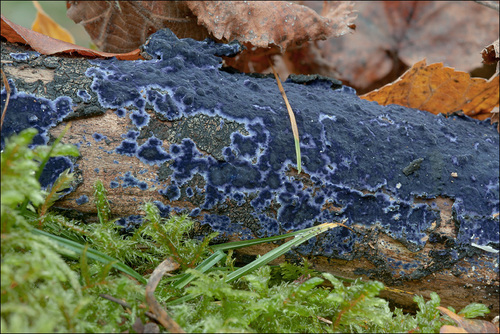
Terana coerulea (Lam.) Kuntze is also referred to as Terana caerulea, or cobalt crust. Its fruiting body is resupinate, meaning it grows along the surface of its substrate with the spore-producing hymenium layer exposed to the outside. The fruiting body measures 2–6 mm thick, is dark blue with a paler margin, and has a velvety or waxy texture when moist, becoming crusty and brittle when dry. It is firmly attached to its growing surface except along its outer edges. In its natural habitat, the spore-producing surface of the fungus typically faces downward to help facilitate spore dispersal. This fungus usually grows on dead deciduous wood, most commonly ash, maple, oak, and hazel. It produces a white spore print. Its individual spores are ellipsoidal, smooth, thin-walled, and hyaline or pale blue, with dimensions ranging from 7–12 by 4–7 μm. Its four-spored club-shaped basidia are hyaline or blue, with dimensions of 40–60 by 5–7 μm. The cobalt crust has a worldwide distribution across warmer climates, and has been reported from Asia, Africa, New Zealand, Eastern North America, the Canary Islands, Europe, Taiwan, Thailand, and Turkey.