About Tephroseris palustris (L.) Fourr.
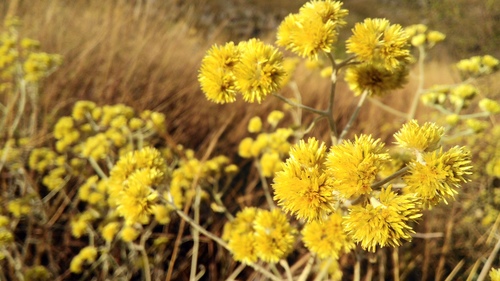
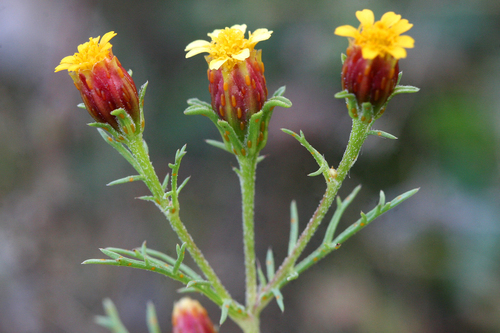
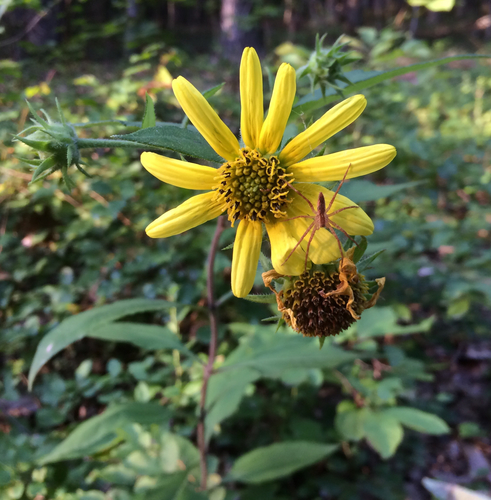
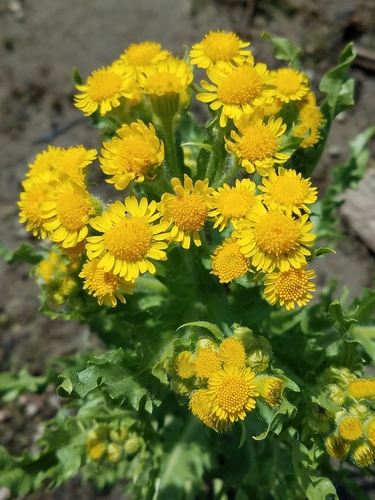
Tephroseris palustris (also referenced by synonyms Senecio congestus and S. congestus, common name marsh ragwort) is most often an annual or biennial plant, and may rarely be perennial depending on growing conditions. It is a broad-leaved, villous plant with a single hollow stem, and favors mud flats, similar to Marsh Groundsel (Senecio hydrophilus). Unlike Marsh Groundsel, marsh ragwort cannot tolerate alkaline sites or standing water. In early growth stages, its leaves, stem, and flower heads are all covered with translucent hairs. These hairs create a "greenhouse effect" near the plant surface, warming plant tissues and preventing heat loss, which extends the growing season by a few critical days. This erect plant grows 15 to 150 cm (6 to 60 inches) tall. Its stature varies widely, as does the distribution and persistence of its tomentum, the fine, closely matted hairs on its leaves. Stems are sparsely to densely villous, more hollow toward the base, and bear hairs that are white, light yellowish, or reddish brown. Basal and cauline leaf edges are mostly toothless, or have a few coarse teeth, and leaves sometimes wither before flowering. All leaves are basically similar in shape, being oblong; lower leaves are often spatulate. Leaves measure 4 to 20 cm (1.6 to 8 inches) long and 0.5 to 6 cm (0.2 to 2.5 inches) wide; basal leaves are occasionally larger. Leaves may be glabrous or villous in patches, have rounded tips, and are toothed, often deciduous, with clasping bases. It produces "congested" clusters of several to many pale yellow flower heads, which sometimes appear tubular and incompletely opened. The inflorescence is branched, with 13 to more than 21 flower heads per stalk. Each flower head is 6 to 13 mm (¼ to ½ inch) across and 0.4 to 10 mm (0.16 to 0.4 inch) in length. It has small but obvious rays in the corolla laminae, surrounded by (usually) 21 green or yellowish green, pink-tipped bracts that may be scarious toward the tips. Tephroseris palustris produces dry, one-seeded, one-celled achenes 1.5 to 2.5 millimetres long that are strongly accrescent, borne on very fine, numerous, white or dirty white, fluffy pappus bristles. Its seeds have been shown to survive in soil for more than one year but less than five years; maximum seed longevity is unknown. Its root system is fibrous and lacks a tap root. Tephroseris palustris grows in regions with freezing winters, in moist to wet soils, in habitats such as damp meadows, swamps, sandy pond edges, and roadside ditches, at altitudes from 0 to 1,000 m (0 to 3,300 feet). It is the most common annual plant species in the eastern Canadian Arctic. It is native to North America (found in Alaska, Iowa, Michigan, Minnesota, North Dakota, South Dakota, Wisconsin, British Columbia, Alberta, Saskatchewan, Manitoba, Ontario, Quebec, New Brunswick, Nova Scotia, Prince Edward Island, Newfoundland and Labrador, Yukon, Northwest Territories, Nunavut), northwestern Asia (found in Astrakhan Oblast, Bashkortostan, Belgorod Oblast, Bryansk Oblast, Chuvashia, Franz Josef Land, Kalmykia, Kaluga Oblast, Kirov Oblast (also called Vyatka), Kursk Oblast, Lipetsk Oblast, Mordovia, Novgorod Oblast, Novaya Zemlya, Orenburg Oblast, Penza Oblast, Perm Krai, Pskov Oblast, Rostov Oblast, Ryazan Oblast, Saint Petersburg, Samara Oblast, Saratov Oblast, Tambov Oblast, Tatarstan, Tula Oblast, Ulyanovsk Oblast, Udmurtia, Volgograd Oblast, Voronezh Oblast), and Europe (found in Northern Europe: Denmark, Estonia, Latvia, Sweden; Middle Europe: Czech Republic, Poland; East Europe: Belarus, Kaliningrad Oblast, Lithuania, Ukraine; West Europe: France, Luxembourg, Netherlands; Southeastern Europe: Croatia). Its current distribution matches its native distribution, with updated records adding Slovakia to Middle Europe, Belgium to West Europe, and Andorra, Gibraltar, and Spain to Southwestern Europe, and notes that populations are decreasing in Estonia. Young leaves and flowering stems of this species are considered safe for human consumption: they can be eaten raw in salads, cooked as a potherb, or made into sauerkraut. Tephroseris palustris appears on a list of plants to be monitored in North Dakota. However, its presence generally indicates severe habitat disturbance such as over-foraging and hyper-salinity, which occurs in arctic goose habitats where forage plants are disappearing. Multiple locations with expanding arctic goose populations have recorded widespread occurrence of this species: on Akimiski Island (Northwest Territories, Canada), replacement of swards of Puccinellia phryganodes and Carex subspathacea with dead willow stands and mudflats growing non-forage plant species including this species; in the Cape Churchill Region and La Pérouse Bay, Manitoba, expanding lesser snow goose populations have substantially altered intertidal habitats, and this species and Salicornia borealis are widespread near the coast; at Karrak Lake, Nunavut, growing populations of Ross's geese and lesser snow geese have caused a decline in vegetative cover, and this species is more common in areas with 10 or more years of goose nesting history than in areas with less than 10 years of nesting. Tephroseris palustris is reported to be extirpated in Michigan.