About Telicota colon (Fabricius, 1775)
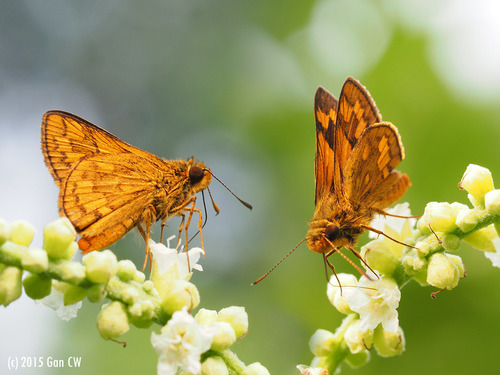
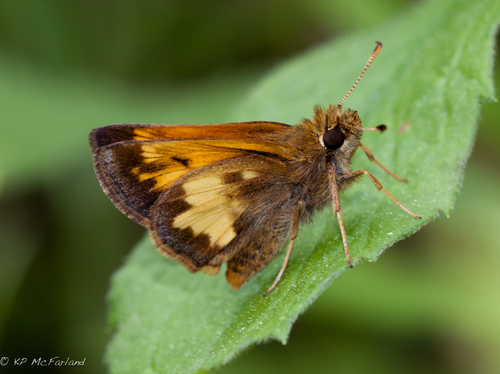
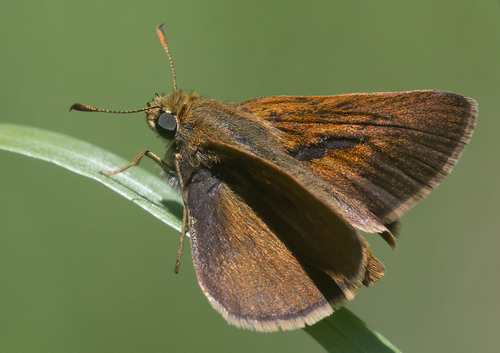
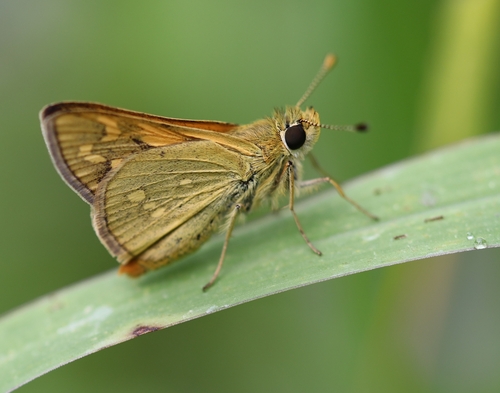
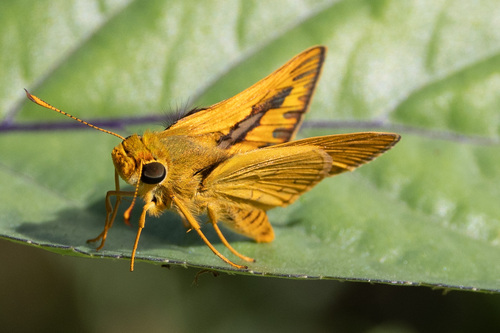
This is a description of the species Telicota colon, originally published by Fabricius in 1775. For male individuals: Upperside. The forewing is golden-ochreous, with black lines along the costa and outer margin. There is a narrow, pale blackish streak beneath the upper and lower margins of the cell, and a broad, more or less oval-shaped black band extending from the lower end of the cell to the middle of the sub-median vein. This band contains a linear discal stigma along its entire length, with some pale, obscure spots continuing upwards toward the wing apex. All veins are black, with some blackish suffusion on the hinder marginal area below the sub-median vein. There is also a black, macular marginal band made of elongated square spots, which decrease in size upwards, with one spot in each interspace. The hindwing is black, with a rather large golden-orange spot at the end of the cell, and a large discal patch of the same golden-orange colour. The patch extends from above vein 6 to below vein 2, where it joins a golden-yellow streak that runs through interspace 1 from its base to its end. Black veins 2, 3, 4 and 6 divide the patch into elongated spots, which are mostly scalloped on their outer sides and rounded on their inner sides. The cilia of both wings are yellow, with brown markings on the upper part of the forewing. Underside. The forewing is brownish-ochreous; the basal half of the cell, the space below the cell, and the discal band are black. The discal band has some diffused marks and spots that continue up to the apex. The outer marginal band seen on the upperside is represented obscurely down to vein 2, from where it continues as broad black around the hinder angle. All veins are black. The hindwing is brownish-ochreous, somewhat darker than the forewing, and the margins of the discal patch are marked by black spots. Antennae are black and white on the underside, the shaft is spotted with black, and the club has a dull red tip. Palpi are ochreous above and white below, the pectus is white. Head and body are brown above, covered with ochreous hairs, and the abdomen is whitish beneath. For female individuals: Upperside, both wings are mostly blackish-brown. The forewing has an ochreous streak along the costa, an ochreous spot at the end of the cell, three sub-apical ochreous spots, and a discal outwardly oblique ochreous band divided by veins into elongated spots starting from the sub-median vein. The spots narrow upwards, are excavated on their outer sides, and end in two small spots or dots toward the apex, located outside the lower end of the sub-apical spots. The hindwing has a discal ochreous band and abdominal streak matching those of the male. The cilia of both wings are whiter than in males. The underside is much like that of the male. On the upperside, the extent and breadth of the ochreous markings varies between different individuals. Known larval host plants for this species are Bambusa vulgaris, Phragmites karka, Oryza, Saccharum and Ochlandra travancorica.