About Telekia speciosa (Schreb.) Baumg.
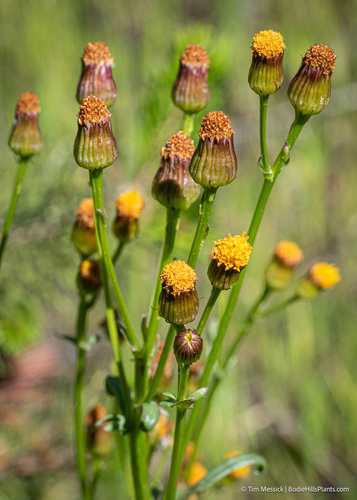
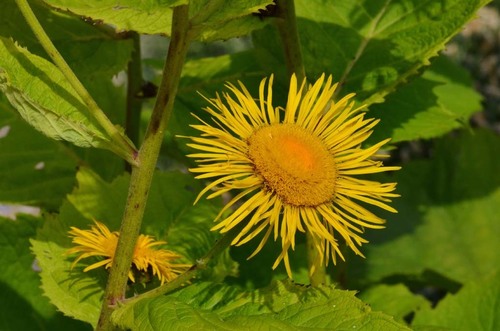
Telekia speciosa (Schreb.) Baumg. is a herbaceous perennial plant that can grow up to 2 metres tall. Its leaves are green, triangular, doubly-serrate, and long-petioled, ranging from 10 to 40 cm in length. The upper surface of the leaves is glabrous, while the undersides have hairs. Younger ovate stem leaves are sessile. This species blooms from early summer to early autumn. Its flowers grow on slender stems, have a daisy-like appearance, and feature ragged yellow petals. This species is native to large parts of Europe, including Albania, Bulgaria, the Czech Republic, Greece, Hungary, Romania, Turkey, Ukraine, Slovakia, and North Macedonia. It is also native to the Baltic states, North and South Caucasus, and Central and Northwest European Russia. Outside of its native range, Telekia speciosa has been introduced to multiple European countries: Austria, Belgium, Denmark, Estonia, Finland, France, Germany, Great Britain, Ireland, Italy, Latvia, Norway, Poland, Sweden, and Switzerland. It has also been introduced to the United States, Canada, and Japan. Telekia speciosa is an adaptable species that can grow in a wide variety of habitats. It is most often found in damp, shaded, nitrogen-rich woodland, but also occurs in forests, glades, meadows, and mountainous habitats. It is frequently found growing in damp soil on the banks of lakes, rivers, and streams, and is also associated with heavily disturbed habitats like wasteland. This species grows well in partially shaded environments. It can grow in full sun, but may develop foliage necrosis during drought, and plants grown in full shade become stunted. It grows best in damp clay soils free of calcium carbonate, though it can also grow in sandy, loam, or chalk soils. It grows at elevations between 300 and 1700 metres above sea level. Outside its native range, Telekia speciosa is sold and sometimes used as an ornamental garden plant. The flowers of Telekia speciosa are used by a wide variety of pollinating insects, including multiple species of bees, butterflies, and hoverflies. Recorded butterfly species that feed on its flowers include the European peacock (Aglais io), common swallowtail (Papilio machaon), green-veined white (Pieris napi), and high brown fritillary (Argynnis adippe). The bee species Bombus semenoviellus (a bumblebee) also pollinates its flowers. Seed-eating birds including the goldfinch (Carduelis carduelis) and other finch species consume its seeds. Telekia speciosa is the only food plant for the aphid Uroleucon telekiae, which is monophagous and does not feed on any other plant species. Two fungi can infect Telekia speciosa: Golovinomyces cichoracearum, which causes powdery mildew, and Coleosporium telekiae, which causes rust.