About Technomyrmex jocosus Forel, 1910
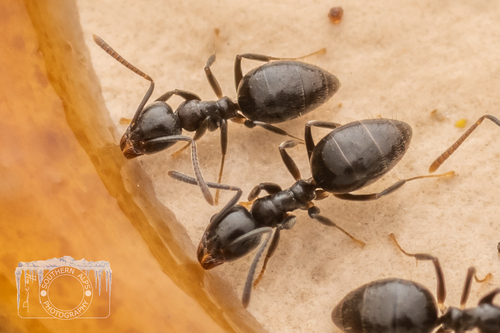
Technomyrmex jocosus is frequently misidentified as Technomyrmex albipes, and both species share the common name white-footed ant. Worker T. jocosus measure between 3.0 and 3.4 mm (0.12 to 0.13 in) in length, and have 12 antenna segments. There are several key features that separate T. jocosus from T. albipes. The arrangement of setae on the head differs: T. jocosus has a pair of setae on the back of the head, behind the eyes. T. jocosus also has longer dorsal setae on its abdomen. Its head is shinier and less sculpted than the head of T. albipes, and its compound eyes are larger than those of T. albipes. Unlike many other common ant genera found in its range, T. jocosus does not have a petiolar node, the section of the body located just before the abdomen. Technomyrmex jocosus is a very common Technomyrmex species native to Australia. It occurs in both south-eastern and south-western Australia, where it lives primarily in moderately moist, densely wooded areas such as forests. It also nests in suburban locations including fence posts and gardens, and often invades residential homes. It has never been recorded in drier Australian regions like the Outback. T. jocosus has been introduced to New Zealand as an invasive species. While detection and removal efforts at national borders exist, established nests can be found in open country and forests across the country, and the species occurs in suburban, forested, and open areas of New Zealand's North Island. After accidental introduction, it spread through suburban areas around North Island ports, and nests in suitably moist open forests. Just as in Australia, it can be found under rotten logs, in crevices, and inside housing wall cavities, which makes it a household pest. Established populations are known from parts of the North Island, especially around Auckland and Wellington, but the species has also been recorded further south, mainly around Marlborough, and as far south as Christchurch. T. jocosus is a ground-dwelling ant species that typically forages for food in trees. It farms wild hemipteran species such as aphids to collect honeydew. In Australia, large populations of T. jocosus have been found around karri trees (Eucalyptus diversicolor). It primarily lives in moderately moist habitats, occupying dead wood, crevices, large cracks in stones, and spaces under tree bark; these locations support its foraging habits as it searches for prey and honeydew.