About Tayassu pecari (Link, 1795)
Scientific Nomenclature
The white-lipped peccary, scientifically named Tayassu pecari (Link, 1795), is a pig-like ungulate.
Pelage Coloration
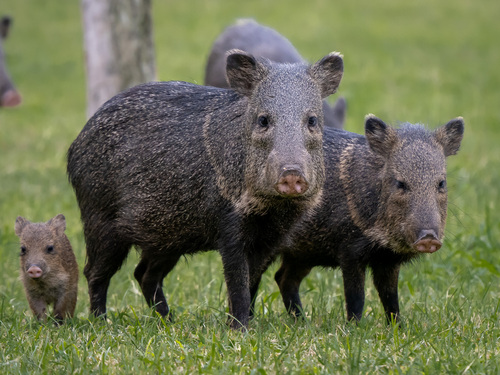
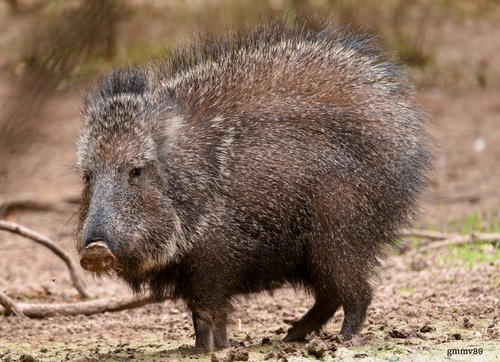
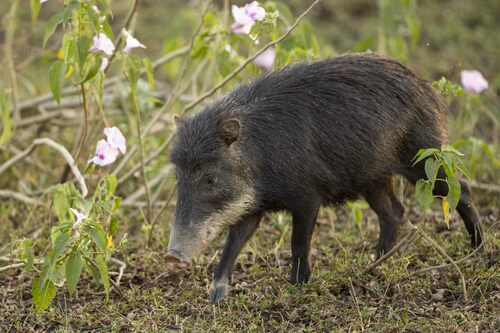
It is covered in dark hair, with cream-colored hair on parts of its underside, including the throat and pelvic regions.
Adult Size Measurements
Adult white-lipped peccaries reach a length of 90–135 cm (35–53 in), stand about 90 cm (35 in) tall at the shoulder, and usually weigh 27–40 kg (60–88 lb), though some individuals grow larger.
Sexual Dimorphism
There is no obvious sexual dimorphism in the species, but males have longer canine teeth than females.
Scent Gland Location
The white-lipped peccary has a scent gland located on the posterior mid-dorsal region.
Native Range
This species is native to Argentina, Belize, Bolivia, Brazil, Colombia, Costa Rica, Ecuador, French Guiana, Guatemala, Guyana, Honduras, Mexico, Nicaragua, Panama, Paraguay, Peru, Suriname, and Venezuela.
Regional Extinction
It is regionally extinct in El Salvador.
Habitat Types
White-lipped peccaries thrive in dense, humid, tropical forests, but can also be found in a wide range of other habitats: dry forests, grasslands, mangroves, dry xerophytic areas, and the Cerrado ecoregion of Brazil.
Altitudinal Range
Their range extends from sea level up to an altitude of 1,900 m (6,200 ft), and overlaps with the range of the collared peccary.
Mesoamerican Range Decline
A 2018 study found that white-lipped peccaries have disappeared from 87% of their historical range in Mesoamerica, which the study defined as all areas between southern Mexico and Panama.
Mesoamerican Conservation Status
The study reported that the species is in "critical condition" in the seven Mesoamerican countries it still inhabits.
Country-Specific Population Declines
Studies by the International Union for Conservation of Nature found similar results, with a reported 89% decline in Costa Rica, and an 84% decline in Mexico and Guatemala.
Herd Movement Pattern
White-lipped peccaries generally travel in large herds. Unlike the collared peccary (Dicotyles tajacu), which travels single-file, T. pecari moves in broad groups.
Herd Size Range
Group sizes range from fewer than ten individuals (groups as small as five have been recorded, though this is uncommon) to as many as 300. Very large groups are rarer now than they were historically, due to the species' declining population.
Atlantic Forest Herd Size
In a fragmented area of the Atlantic Forest, the average recorded group size was around 42 individuals.
Herd Interactions
Herds frequently come into contact with one another and interbreed.
Juvenile Herd Composition
Studies found that juvenile peccaries make up no more than 20% of any given herd.
Range Overlap with Collared Peccary
As noted earlier, the range of T. pecari overlaps significantly with that of D. tajacu, and both species occupy similar habitats across the Neotropics.
Bite Force Comparison
A 1982 published study found that the bite force of white-lipped peccaries is at least 1.3 times as great as that of collared peccaries.
Niche Differentiation
This may help explain how the two species coexist across such a large area, as the study also found that when foraging in the same area, the two species consume different types of seeds and nuts. The measured hardness resistance of these seeds and nuts aligns with the different bite forces of the two peccary species.
Travel Vocalizations
When traveling in herds, white-lipped peccaries can produce screaming noises and clack their teeth. These sounds can be heard from hundreds of meters away, and they help maintain group coherence and intimidate potential predators.
Full Vocal Repertoire
In common with other peccaries, their vocal repertoire includes low-frequency barking, growling, moaning, high-pitched squealing, and tooth clacking, per GBIF records.
Breeding Season
White-lipped peccaries breed year-round.
Estrus Cycle Length
The estrus cycle typically lasts around 18 to 21 days.
Gestation and Litter Size
After a gestation period of about 158 days, females usually give birth to two young.
Newborn Mobility
Newborn white-lipped peccaries are able to travel with the rest of the herd just hours after birth.