About Taxus baccata L.
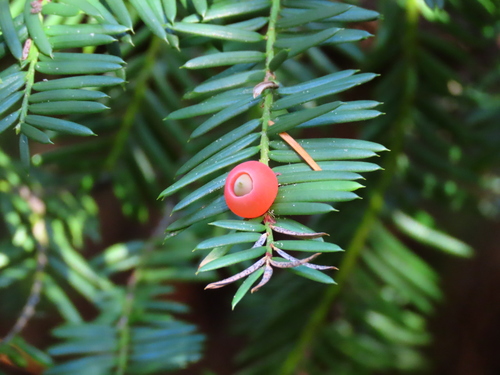
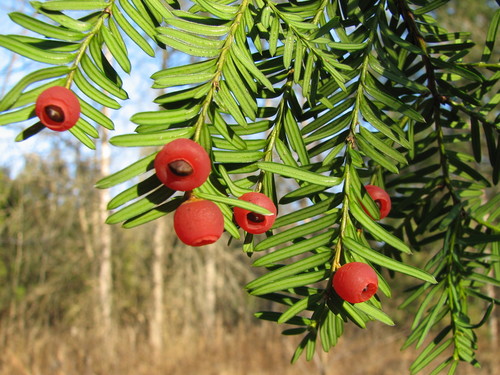
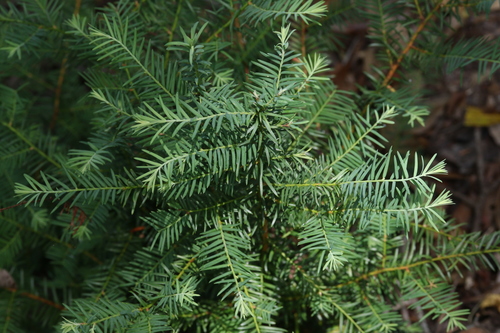
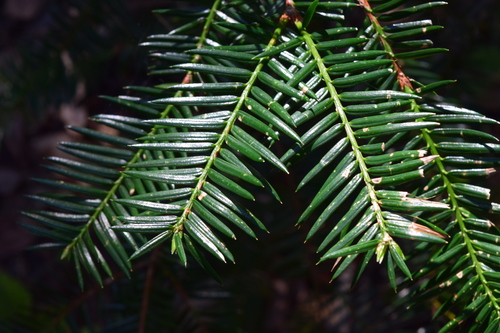
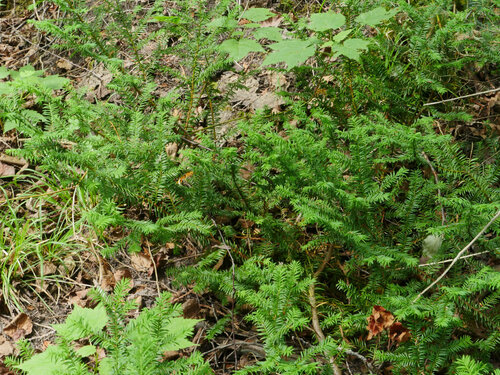
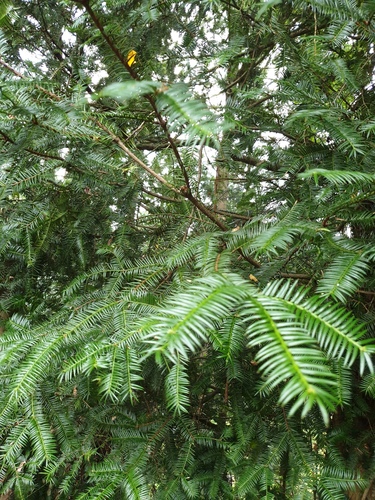
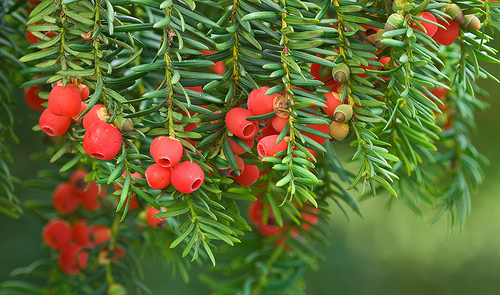
Taxus baccata L., commonly known as yew, is a small to medium-sized evergreen tree. It typically reaches 10–20 metres (35–65 ft) in height, and can exceptionally grow up to 28 m (92 ft) tall. Its trunk usually reaches up to 2 m (6+1⁄2 ft) in diameter, with an exceptional maximum of 4 m (13 ft). The bark is thin, scaly reddish-brown, and sheds in small flakes aligned with the stem. Leaves are flat, dark green, 1–4 centimetres (1⁄2–1+1⁄2 in) long and 2–3 millimetres (1⁄16–1⁄8 in) broad. Leaves are arranged spirally on the stem, but their bases twist to align the leaves into two flat rows on either side of the stem; this spiral arrangement is more prominent on erect leading shoots. Seed cones of yew are modified, with each cone holding a single 4–7 mm (3⁄16–1⁄4 in) long seed. The seed is almost entirely surrounded by a fleshy scale that develops into a soft, bright red, berry-like aril. The aril is 8–15 mm (5⁄16–9⁄16 in) long and wide, open at the end, gelatinous and very sweet tasting. Arils mature 6 to 9 months after pollination. Male cones are globose, 3–6 mm (1⁄8–1⁄4 in) in diameter, and shed their pollen in early spring. Yews are mostly dioecious, meaning male and female cones grow on separate trees, but occasional individuals can be variably monoecious, or change sex over time. Yew is native to every country in Europe except Iceland, the Caucasus, and extends east from Turkey to northern Iran. Its range reaches south to Morocco and Algeria in North Africa, and into parts of Southwest and South Asia. A small number of populations grow in the Azores and Madeira archipelagos. Frost sensitivity limits the species' northern distribution in Scandinavia, and global warming is predicted to allow it to spread further inland. It has been introduced to other regions, including the United States. The richest central European yew populations are found in Swiss yew-beech woodlands, growing on cool, steep marl slopes up to 1,400 metres (4,600 ft) elevation in the Jura Mountains and Alpine foothills. In England, yew grows best on the steep slopes of chalk downs, where it forms extensive stands that invade grassland outside beech woods. In the more continental climates of Europe, it grows better in mixed forests, including both coniferous and mixed broadleaf-conifer forests. No other plants can grow under the dense evergreen shade of yew. The species prefers steep rocky calcareous slopes. It rarely grows past the sapling stage on acid soil under a forest canopy, but it tolerates a wide range of soil pH when planted by humans, such as in its traditional placement in churchyards and cemeteries. Some of the largest and oldest yew trees in northwestern Europe are found in these locations. It grows well in well-drained soils, and tolerates nearly any soil type; it is most commonly found in humus and base-rich soils, but will also grow on rendzina and sand soils if adequate moisture is available. Yew can survive temporary flooding and moderate droughts. Its roots can penetrate extremely compressed soils, such as those on rocky terrain and vertical cliff faces. It normally occurs individually or in small groups in forest understories, but forms continuous stands across its range in sheltered calcareous sites. Yew is extremely shade-tolerant, and has the widest temperature range for photosynthesis among European trees, allowing it to photosynthesize in winter after deciduous trees have lost their leaves. It can grow under partial canopies of beech and other deciduous broad-leafed trees, but only grows into a large tree without this overhead shade. Yew arils are eaten by birds, which disperse the undamaged hard seeds through their droppings. Although the seeds contain toxins, the kernels are extracted and eaten by some bird species including hawfinches, greenfinches, and great tits. Every part of the yew plant is poisonous, except for the aril, the red fleshy covering of the seed. Yews contain numerous toxic compounds, including alkaloids, ephedrine, nitriles, and essential oil. The most significant toxins are taxine alkaloids, which are cardiotoxic compounds that act via calcium and sodium channel antagonism. If any yew leaves or seeds are ingested, urgent medical attention is recommended, with observation for at least six hours after ingestion. Yew poisonings are relatively common in both domestic and wild animals that consume the plant accidentally, and cause frequent livestock fatalities. Taxines are absorbed efficiently through the skin. Rabbits and deer have some level of immunity to the poisonous alkaloids. According to researcher Ondřej Piskač, the reported lethal dose of yew needles for an adult human is 50 g. Patients who ingest a lethal dose frequently die from cardiogenic shock, even with resuscitation efforts. There are currently no known antidotes for yew poisoning, but medications such as atropine have been used to treat poisoning symptoms. Taxine remains present in the plant year-round, with the highest concentrations occurring during the winter. Dried yew plant material retains its toxicity for several months, and even becomes more toxic as water is removed. Fallen leaves should therefore also be considered toxic. Poisoning most often occurs when yew leaves are eaten, but at least one poisoning case occurred when a victim inhaled sawdust from a yew tree. Historically, yew wood was important, and was used in the Middle Ages to make items including musical instruments, furniture, and longbows. Overharvesting for this use left the species nearly extinct across much of Europe. Today, yew is not grown as a commercial crop due to its very slow growth, but it is valued for hedging and topiary. Certain compounds from yew clippings are precursors for the chemotherapy drug taxol.