About Taxidea taxus (Schreber, 1777)
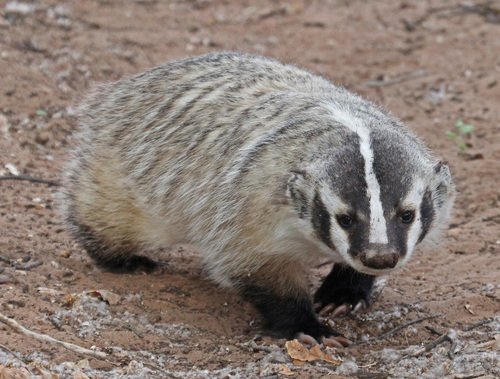
The American badger (Taxidea taxus) shares most general characteristics common to badgers: it has a stocky, low-slung body with short, powerful legs, and is identifiable by its huge foreclaws that measure up to 5 cm in length, plus distinctive head markings. It has multiple morphological adaptations that make it a specialized fossorial (digging) species, including a conical head, bristles on the ears, and nictitating membranes in the eyes. It has powerful forelimbs, a strong humerus, and large bony processes for muscle attachment. The mechanical advantage of its forelimbs is increased by a specialized olecranon process, as well as specialized structures in the radius and metacarpals. American badgers generally measure between 60 and 75 cm (23.5 and 29.5 in) in total length, and males are slightly larger than females. Average weight is roughly 6.3 to 7.2 kg (14 to 16 lb) for females, and up to 8.6 kg (19 lb) for males. Northern subspecies such as T. t. jeffersonii are heavier than southern subspecies. In fall, when food is abundant, adult male badgers can reach weights of 11.5 to 15 kg (25 to 33 lb). In some northern populations, females can average 9.5 kg (21 lb). Except for the head, the American badger is covered in a grizzled coat of coarse fur in shades of brown, black, and white, which gives it an overall mixed brown-tan appearance. This coat helps it camouflage in grassland habitats. Its triangular face has a distinctive black and white pattern, with brown or blackish "badges" marking the cheeks and a white stripe that runs from the nose to the base of the head. In the subspecies T. t. berlandieri, this white head stripe extends the full length of the body, all the way to the base of the tail. American badgers prefer grasslands and other open areas that include grass, such as parklands, farms, and treeless areas with friable soil and an available population of rodent prey. They may also be found in forest glades and meadows, marshes, brushy areas, hot deserts, and mountain meadows. They are sometimes found at elevations up to 12,000 feet (3,700 m), but usually occur in the Sonoran and Transition life zones, which are lower and warmer than the elevations dominated by coniferous forests. In Arizona, they live in desert scrub and semi-arid grasslands. In California, American badgers survive primarily through a combination of open grasslands on agricultural lands, protected land trust and open space lands, and regional, state, and national park lands that have grassland habitat. They are occasionally found in open chaparral (with less than 50% plant cover) and riparian zones, but are not usually found in mature chaparral. In Manitoba aspen parklands, the abundance of American badgers is positively associated with the abundance of Richardson's ground squirrels (Spermophilus richardsonii). In Ontario, the species primarily lives in the extreme southwestern portion of the province, restricted to the north shore of Lake Erie in open areas generally associated with agriculture and along woodland edges; there have been a small number of reports from the Bruce-Grey region. American badger home range use varies by season and sex. Different parts of the home range are used more often in different seasons, and this variation is usually related to prey availability. Males generally have larger home ranges than females. A 1972 study of radiotransmitter-tagged American badgers found an average annual home range of 2,100 acres (850 hectares). One female studied had a home range of 1,790 acres (720 hectares) in summer, 131 acres (53 hectares) in fall, and just 5 acres (2.0 hectares) in winter. Lindzey reported average home ranges ranging from 667 to 1,550 acres (270 to 627 ha). In Utah scrub-steppe, estimated population density of American badgers is one individual per square mile (2.6 km2), with 10 dens in active or recent use. As of 2014, overdevelopment of American badger habitat has led to a reduced range, decreased prey populations, and forced badgers into contact with humans when they forage between fragmented habitat patches. Direct observations in Sonoma County, which documented habitat, badger sightings, and foraging behavior, show that individual ranges within fragmented habitat areas range from less than 1/2 mile to approximately 4 miles. Within these areas, prey availability and access to a fresh water source are key factors determining preferred habitat areas and the species' ability to survive. Identifying and conserving habitat areas that support year-round activity, along with understanding the species' burrowing patterns and the territories female badgers use for birthing and raising young, have become critical factors for the survival of the species. American badgers are normally solitary animals, but are thought to expand their territories during the breeding season to seek out mates. Mating occurs in late summer and early fall, and some males breed with more than one female. American badgers have delayed implantation: pregnancies are suspended until December, or as late as February. Young are born between late March and early April, in litters of one to five young, with an average litter size of about three. Newborn badgers are born blind, already covered in fur, and helpless. Their eyes open at four to six weeks of age. The female provides her young with solid food before full weaning, and continues to do so for a few weeks after weaning is complete. Young American badgers first emerge from the den on their own at five to six weeks old. Family groups usually break up, and juveniles disperse, between the end of June and August; young American badgers may leave their mothers as early as late May or June. Juvenile dispersal movements are erratic. Most female American badgers become pregnant for the first time after they reach one year of age. A small minority of females four to five months old ovulate, and a few become pregnant. Males usually do not breed until their second year. Large predators occasionally kill American badgers. The average longevity of American badgers in the wild is 9–10 years, with a wild record of 14 years; one captive individual lived at least 15 years and five months.