About Tatosoma tipulata (Walker, 1862)
Scientific name: Tatosoma tipulata (Walker, 1862)
Hudson provided the following description of this species' egg: It is roughly 1/40th of an inch long, oval, noticeably flattened on both sides, covered in very shallow hexagonal depressions, and deep ochreous-yellow in colour. It is laid on its side. Roughly two days after being laid, the side becomes strongly concave, and the colour changes to reddish-orange. Eggs of this species were collected in early December.
Hudson also described the newly emerged larvae of this species: A newly emerged larva is less than 1/10th of an inch long; it is stout and cylindrical, with a very large head and second segment, tapering to the fifth segment, then becoming slightly stouter further along. The anal flap is bifid, and the anal prolegs extend widely laterally. Its general colour is bright yellow, with a slight brownish tint on the back, especially towards the posterior end. Segmental divisions are very distinct and deep yellow, with a small number of extremely minute black warts. Hudson noted that mature larvae of this species have variable colouration. He reared multiple T. tipulata larvae to adulthood, and confirmed the species identity of each after they completed metamorphosis.
The pupa of T. tipulata is just under 1 inch long, thin in appearance, and greenish brown, with a lighter shade on the wing cases.
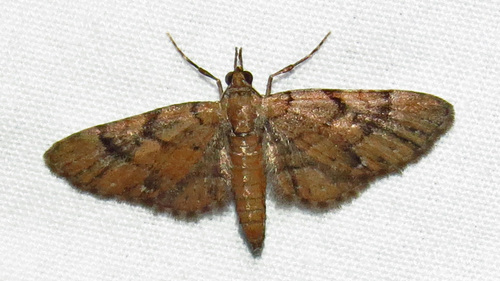
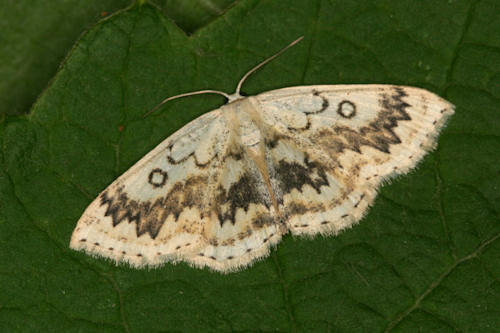
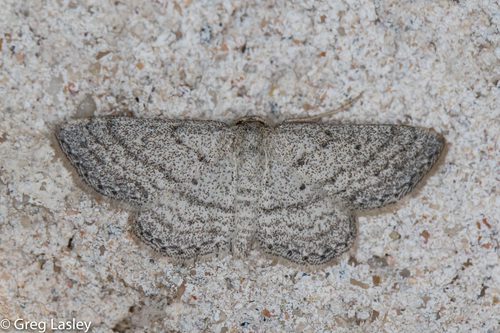
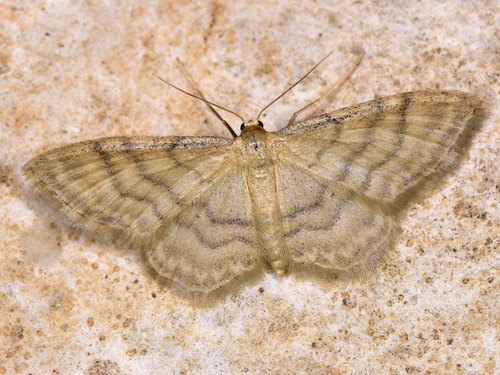
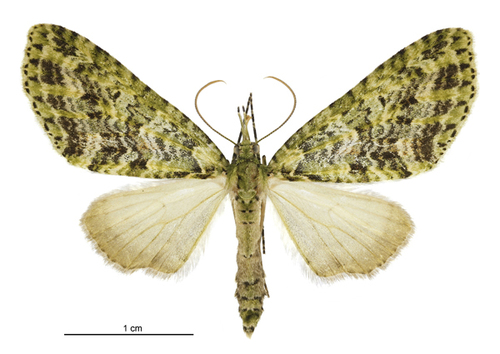
Walker described the adults of this species as follows: Both males and females are olive-green. The palpi are as long as the head is broad, with a very small third joint. The antennae are stout and smooth. The abdomen is cylindrical, slender, and very long, especially in males; in males, the abdomen extends half its length beyond the hind wings, and has a few black points on each side. The fore wings are long and narrow, slightly rounded at the tips, marked with several undulating, irregular brown or blackish lines. The middle space of the wing has two irregular, close-set brownish bands; the discal streak is brown; the fringe has paired black points; the exterior border is extremely oblique. The hind wings are cinereous; the interior border is excavated, and has an inflated lappet towards the base. The body is 9 lines long, and the wings are 18 lines long.
Hudson also gave an adult description: The wing expansion is about 1+1⁄2 inches. The fore-wings are bright-green, crossed by numerous black wavy transverse lines; these black lines are grouped into four more or less distinct bands, the outermost of which is interrupted at each vein. There is a conspicuous black dot in the middle of the wing, a number of small triangular subterminal black marks, and a series of minute terminal black dots. The hind-wings are ochreous, with a green tinge towards the termen. Females have a much shorter abdomen and larger hind-wings than males. The palpi are fully twice as long as those of female T. agrionata.
T. tipulata is very similar in appearance to T. agrionata and can be confused with that species. T. tipulata can be distinguished by its Z-shaped basal line, and by the absence of the conspicuous large pale patch near the tornus that is present on T. agrionata. Robert Hoare also noted that T. agrionata has a very distinct black V on the forewing dorsum near the base, which is a distinguishing feature that is not present on T. tipulata.
This species is endemic to New Zealand, and can be found in the North Island, the South Island, and Stewart Island. It inhabits dense native forest. The larval host plants of this species are Pterophylla racemosa, Nothofagus cliffortioides, and Podocarpus totara; larvae feed on the leaves of these trees.