About Tarsipes rostratus Gervais & Verreaux, 1842
General Appearance
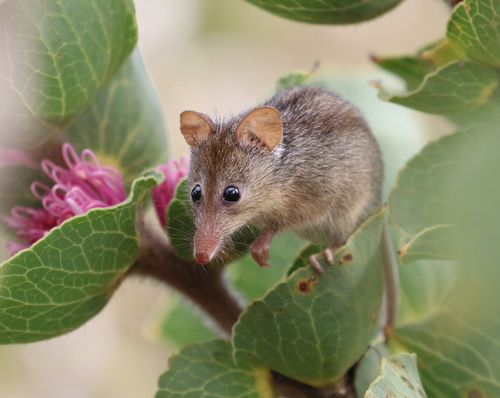
Honey possums (Tarsipes rostratus) are small animals that somewhat resemble voles. Their underfur is cream-colored, which blends into rufous coloration at the flanks, while the upperparts have an overall mix of brown and grey hairs.
Distinguishing Markings
They are easily identifiable by their exceptionally long muzzle and three brown stripes running from the head to the rump: a dark brown central stripe stretches from the rump to a point halfway between the ears, and this stripe is more distinct than the two paler stripes positioned adjacent to it.
Tail Measurements
Their tail measures 70 to 100 millimetres (2.8 to 3.9 inches), which is longer than their combined head and body length of 65 to 85 mm (2.6 to 3.3 inches).
Tail Function
The tail is prehensile, and helps the animal when climbing.
Weight Range
The recorded weight range for the species overall is 5 to 10 grams (0.18 to 0.35 oz); male honey possums weigh 7 to 11 g (0.25 to 0.39 oz), while females weigh 8 to 16 g (0.28 to 0.56 oz), roughly half the weight of a mouse.
Total Body Length
Their total body length ranges from 6.5 to 9 cm (2.6 to 3.5 in).
Tooth Structure
Honey possums have fewer teeth, and most teeth are much smaller than is typical for marsupials, with molars reduced to tiny cones. Their dental formula is I2/1 C1/0 P1/0 M3/3, giving a total of no more than 22 teeth.
Feeding Adaptations
The jaw and dentition morphology of their elongated snout has several unique characteristics adapted for their specialized feeding as a palynivore (pollen-eater) and nectivore (nectar-eater). Tarsipes rostratus has an extensible tongue, with brush-like papillae covering the tongue's tip.
Food Processing Mechanism
The reduced or modified teeth are no longer used for processing food; this function is replaced by the interaction of the tongue, keel-shaped lower incisors, and a fine combing surface on the palate.
Visual Traits
Honey possums have trichromatic vision, similar to some other marsupials and primates, unlike most mammals which have dichromatic vision. Their visual acuity is adapted to detect the bright yellow inflorescences of flowers such as Banksia attenuata.
Lifespan
Their typical lifespan ranges from one to two years.
Distribution Range
This species is restricted to a fairly small range in the southwest of Western Australia, but is locally common and does not appear to be threatened with extinction as long as its habitat of heath, shrubland, and woodland remains intact and diverse.
Habitat Preference
Collection records held at the Western Australian Museum show that honey possums are more common in regions with high Proteaceae diversity, such as Banksia woodlands where plant species are flowering year-round.
Breeding Timing
Breeding in honey possums depends on nectar availability, and can occur at any time of year.
Mating System
Females are promiscuous, mating with many males, and may simultaneously carry embryos from different sires.
Male Reproductive Traits
Sperm competition has led to males having very large testicles relative to their body weight; with a relative mass of 4.2 to 4.6% of body weight, this is among the largest known for any mammal. Honey possum sperm is the largest of any mammal, measuring 365 micrometres total with a tail (flagellum) length of 360 micrometres, and this is also cited as the longest sperm known among mammals.
Embryo Development Triggers
Blastocyst development is tied to day length, and is triggered by shorter photoperiods, but other reproductive processes are prompted by other factors, most likely food availability.
Gestation Details
Gestation lasts for 28 days, and results in a litter of two to four young.
Newborn Characteristics
At birth, honey possum young are the smallest of any mammal, weighing just 0.005 grams (0.00018 oz).
Pouch Development Period
Development and nurturing inside the mother's pouch lasts for around 60 days. After this period, the young emerge fully furred with open eyes, weighing approximately 2.5 g (0.088 oz).
Post-Pouch Development
Soon after emerging, they are often left in a sheltered spot like a tree hollow while the mother forages for food, but within a few days they learn to cling to the mother's back and travel with her. Eventually, the young become too heavy for the mother to carry; they stop nursing at around 11 weeks of age, and shortly after begin establishing their own independent homes.
Subsequent Litter Cycle
As is typical for many marsupials, a second litter is often born once the first litter leaves the pouch, as development of fertilized dormant embryos resumes when the pouch becomes empty.
Fire Resilience
A 23-year study evaluated the effect of wildfire frequency on honey possum populations, and found the species shows resilience to an initial fire in an area and a subsequent burn six years later.
Fire-related Threats
However, increased fire frequency and intensity caused by global warming and prescribed burns can negatively impact the suitability of local habitat for the species.
Pathogen Vulnerability
Honey possums are susceptible to impacts from Phytophthora cinnamomi, a soil-borne fungus-like organism that causes forest dieback in the eucalypt forests and Banksia woodlands of southwest Western Australia. The nine most favored plant species that provide T. rostratus with year-round food include five species that are vulnerable to the withering caused by the P. cinnamomi pathogen.


