About Taraxacum officinale Weber ex F.H.Wigg.
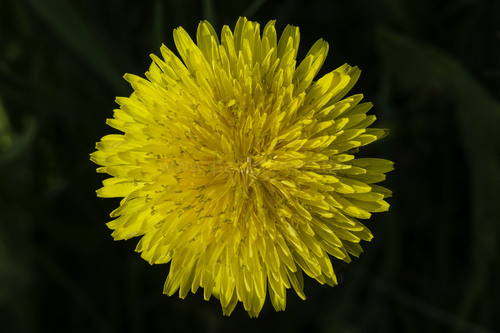
Taraxacum officinale Weber ex F.H.Wigg. grows from a generally unbranched taproot, and produces multiple hollow, leafless flower stems. These stems are typically 5–40 centimetres (2–15+3⁄4 inches) tall, and occasionally reach up to 70 cm (28 in) tall. Stems may have a purplish tint, grow upright or lax, and hold flower heads that are as tall as or taller than the plant’s foliage. Foliage can grow upright or spread horizontally; leaf petioles are either unwinged or narrowly winged. Stems may be hairless (glabrous) or sparsely covered in short hairs. All leaves are basal, and the plant produces milky latex. Each flowering stem has no bracts and bears a single flower head. Yellow flower heads do not have receptacle bracts, and all individual flowers (called florets) are ligulate and bisexual. In many lineages, most seeds are produced by apomixis, though the flowers are frequently visited by a wide range of insects. Leaves are 5–45 cm (2–17+3⁄4 in) long and 1–10 cm (1⁄2–4 in) wide. They are oblanceolate, oblong, or obovate in shape, with bases that gradually narrow toward the petiole. Leaf margins are typically shallowly to deeply lobed, and are often lacerate or toothed with teeth that may be sharp or dull. The calyculi (cuplike bracts that hold the florets) are made of 12 to 18 segments; each segment curves backward and is sometimes glaucous. The lanceolate bractlets are arranged in two series, with acuminate apices. Involucres are 14–25 millimetres (1⁄2–1 in) wide, green to dark green or brownish-green, with dark grey or purplish tips. Each flower head holds 40 to over 100 florets, with yellow or orange-yellow corollas. The fruit, called cypselae, range in color from olive-green or olive-brown to straw-colored or greyish. They are oblanceoloid, 2–3 mm (1⁄16–1⁄8 in) long, and have slender beaks. The fruit have 4 to 12 ribs with sharp edges. The silky, parachute-shaped pappi are white to silver-white and around 6 mm wide. Plants typically have 24 or 40 pairs of chromosomes, while some have 16 or 32 pairs. Taraxacum officinale is native to Europe and Asia, and was originally imported to America as a food crop. It is now naturalized across all of North America (including all 50 U.S. states and most Canadian provinces), as well as southern Africa, South America, New Zealand, Australia, and India. It grows in temperate regions of the world in lawns, along roadsides, on disturbed banks, on the shores of waterways, and other areas with moist soils. It is a very hardy plant that can grow in a wide variety of environments, and is tolerant of crowding, temperature extremes, and low moisture. In regions where growing this plant is more difficult, such as the tropics, it is sought after by collectors, who often smuggle seeds in from overseas. Taraxacum officinale is classified as a noxious weed in some jurisdictions, and is considered a nuisance in residential and recreational lawns across North America. It is also a major agricultural weed that causes significant economic damage, due to widespread infestation of many crops globally. T. officinale acts as an indicator plant for soil potassium and calcium: it favors soils with relatively low calcium concentrations, and soils with relatively high potassium concentrations. Dandelion is a common early colonizer of disturbed habitats, growing from both wind-blown seeds and germinating from stored seeds in the soil seed bank. Seeds can remain viable in the seed bank for many years; one study recorded successful germination after nine years. This species produces large numbers of seeds, with 54 to 172 seeds per flower head. A single plant can produce over 5,000 seeds a year, and dense dandelion stands can produce an estimated more than 97,000,000 seeds per hectare annually. When released, seeds can be carried by wind up to several hundred meters from their parent plant. Seeds are also a common contaminant in crop and forage seed stock. The plants adapt to most soil types, and seeds do not require cold temperatures to germinate, though they must be within the top 2.5 cm (1 in) of soil to germinate. Dandelions can also regenerate from fragments of taproot. T. officinale is a food source for the caterpillars of multiple Lepidoptera (butterflies and moths), including the tortrix moth Celypha rufana. Even though dandelion pollen has poor nutritional quality for honey bees, honey bees readily consume it. It can be an important source of nutritional diversity in heavily managed monocultures such as blueberry farms, or in early spring, as dandelion is one of the first flowering species to bloom. There is no evidence that honey bees reduce their pollination activity on nearby fruit crops when they forage on dandelion. When not in bloom, this species is sometimes confused with other plants, such as Chondrilla juncea, which has a similar basal rosette of foliage. Another plant, often called fall dandelion, is very similar to common dandelion but produces yellow blooms later in the season. Dandelion blooms resemble those of some Sonchus species, but are larger. Dandelion thrives under conditions of elevated carbon dioxide, growing to higher biomass and producing more viable seeds. Because of this, it is expected that dandelion will become more competitive and more widespread as atmospheric carbon dioxide levels increase. It is increasingly recognized in its native regions as an excellent wildflower for attracting pollinating insects and seed-eating birds. One study ranked it as the fourth most important pollen source for pollinators, after willow, meadowsweet and blackberry. Dandelion has been used in traditional herbal medicine in Europe, North America, and China.