About Taraxacum coreanum Nakai
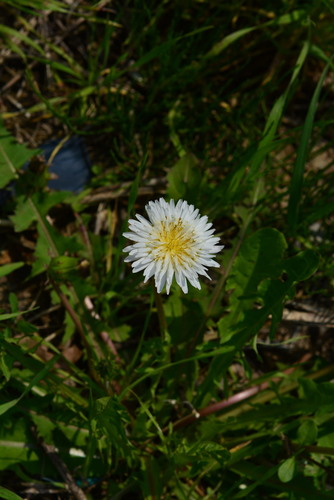
Taraxacum coreanum Nakai is a species of dandelion, a genus of perennial herbaceous plants with taproots that are native to temperate regions of the Northern Hemisphere. Many species in the genus Taraxacum reproduce via apomixis – this is obligate for triploid species – which has led to the formation of many local populations and endemic species. The British Isles alone hosts 234 recognized microspecies (morphologically distinct clonal populations) grouped into nine loosely defined sections. Several Taraxacum species are classified as ruderals, meaning they are pioneer species that quickly colonize disturbed soil. The common dandelion, T. officinale, has been introduced across much of the temperate world, and spreads particularly effectively along roadsides, in cemeteries, lawns, and pastures.
One to two weeks after flowering, the dandelion flower develops into a round seed head. The specialized bracts surrounding the flower curve backward, the parachute ball of seeds fully opens into a sphere, and the yellow petals drop away. Once development is complete, mature seeds are each attached to a white, fluffy "parachute" that easily detaches from the seed head and glides on the wind for dispersal.
Dandelions generally produce simple, lobed to pinnatisect leaves that measure 5–25 cm (2.0–9.8 in) or longer, arranged in a basal rosette that grows above the central taproot. Flower heads range in color from yellow to orange, opening during the day and closing at night. Flower heads are borne on a hollow, usually leafless stem (called a scape) that rises 1–10 cm (0.4–3.9 in) or more above ground. Broken stems and leaves exude a white, milky latex. A single rosette can produce multiple flowering stems at one time. Flower heads are 2–5 cm (0.8–2.0 in) in diameter and are made up entirely of ray florets. They mature into spherical seed heads, sometimes called blowballs or clocks, that hold many single-seeded fruits called cypselae, which are similar to achenes. Each cypsela attaches to a pappus of fine hair-like material, which enables anemochorous (wind-aided) seed dispersal over long distances.
The unique morphology of the pappus allows dandelion seeds to travel large distances during dispersal: it creates a distinct type of vortex ring that remains attached to the seed instead of breaking off downstream. The pappus can also adjust its shape based on atmospheric moisture; this lets the seed plume close to reduce the chance of separating from the stem too early, waiting for optimal conditions that maximize dispersal and germination.
In Taraxacum ovules, only the megaspore mother cell is committed to enter the meiotic process. T. officinale can reproduce both sexually via meiosis that produces haploid gametes, and asexually via a parthenogenetic meiotic process called apomixis that produces diploid seeds genetically identical to the parent plant. Parthenogenesis allows an unreduced egg cell to develop into an embryo autonomously, without needing fertilization.
Taraxacum flowers contain a range of phytochemicals, including polyphenols such as the flavonoids apigenin and isoquercitrin (a quercetin-like compound), and caffeic acid, as well as terpenoids, triterpenes, and sesquiterpenes. The roots contain a large amount of the prebiotic fiber inulin. Dandelion greens contain lutein. A serine proteinase called taraxalisin is found in the latex of dandelion roots. Maximal activity of this proteinase in the roots occurs in April, at the start of plant development after winter. Dandelion seeds produced in spring weigh approximately 0.5 mg, while seeds produced in summer are lighter, at around 0.3 mg.
Though dandelions do not rely on wildlife for pollination or seed distribution, the abundant plant benefits many types of wildlife. Rabbits, wild turkeys, white-tailed deer, eastern chipmunks, bobwhite quail, and many bird species eat dandelion seeds and foliage. Many insects also collect nectar from dandelion flowers, especially in early spring when few other flowers are blooming.
The entire dandelion plant, including leaves, stems, flowers, and roots, is edible and rich in nutrients such as calcium, iron, and vitamins A and K. Dandelions grow wild on every continent except Antarctica, and most commercial varieties are native to Eurasia. As a perennial plant with a taproot, dandelion greens can be harvested repeatedly as long as the root remains in the ground. Raw dandelion greens are high in vitamins A, C, and K, and are a moderate source of calcium, potassium, iron, and manganese. Raw dandelion greens are 86% water, 9% carbohydrates, 3% protein, and 1% fat. A 100 gram (3+1⁄2 oz) reference serving provides 45 Calories.
Dandelions contain bitter, water-soluble sesquiterpenes. Bitterness increases later in the season after flowering, and as leaves mature. To make dandelion greens more palatable, they can be blanched, picked when young, served with other strong flavors, or a combination of these methods. In the Southern United States, dandelion greens are traditionally served with a hot bacon dressing, similar to spinach salad. In Italy, the leaves are sautéed, added to soups, or eaten raw in salads. Dandelion greens have been part of traditional Kashmiri, Lebanese, Spanish, Italian, Albanian, Slovenian, Sephardic Jewish, Chinese, Greek (χόρτα) and Korean cuisines. On Crete, locals eat the leaves of a variety called 'Mari' (Μαρί), 'Mariaki' (Μαριάκι), or 'Koproradiko' (Κοπροράδικο) either raw or boiled in salads. T. megalorhizon, a species endemic to Crete that grows only at high altitudes (1,000–1,600 metres (3,300–5,200 ft)) in fallow areas, is also called pentaramia (πενταράμια) or agrioradiko (αγριοράδικο) and is eaten the same way. Dandelion flower petals, combined with other ingredients usually including citrus, are used to make dandelion wine. Ground, roasted dandelion roots can be used as a caffeine-free alternative to coffee. Dandelion was also commonly used to make the traditional British soft drink dandelion and burdock, and is one of the ingredients in root beer.