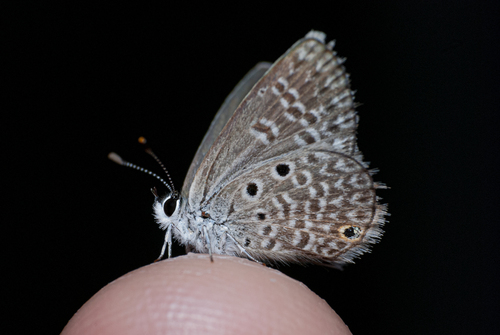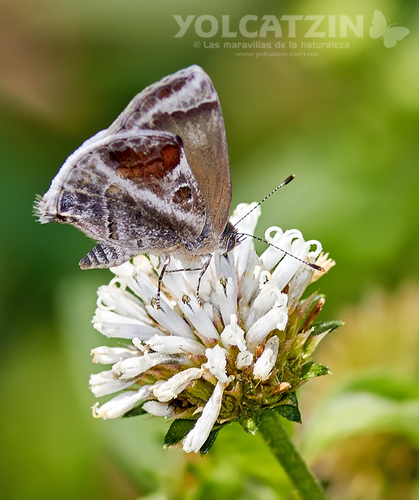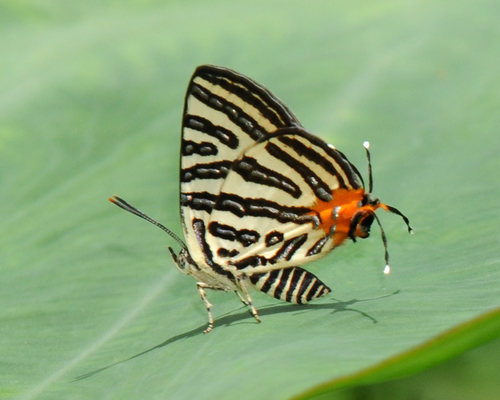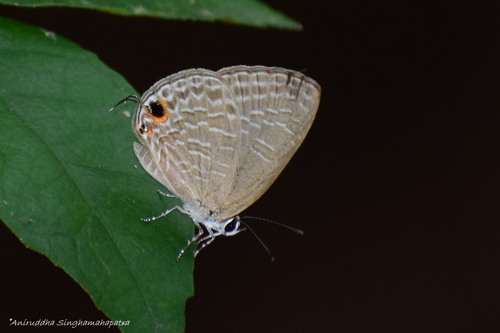
About Taraka hamada (Druce, 1875)
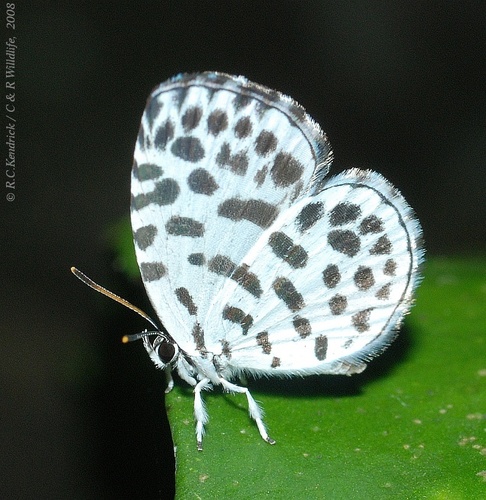
Description: The uppersides of the wings of Taraka hamada are very pale brown; females are somewhat paler, and the wing surfaces are uniform. The black spots present on the wing undersides are faintly visible through the upperside by transparency. The undersides are white, marked with round black spots arranged as follows: On the forewing, there is a spot at the base of the wing, followed in transverse order by two spots, then another two spots, then an irregular row of five spots crossing near the apex of the cell (the lower two of these are coalescent). Beyond that row is another curved row of five spots, two of which are in interspace 3. This is followed by a complete curved series of outward-pointed black spots and a terminal series of inward-pointed black spots of the same shape. The spots in the terminal series cross a distinct but very slender anteciliary black line, which causes the white cilia of the wing to alternate with black patches. On the hindwing, there are similarly five more or less outwardly curved rows of black spots, followed by a slender, uninterrupted anteciliary black line. The antennae, head, thorax, and abdomen are brown. The shafts of the antennae are ringed with white, and the apex of the antenna club is ochraceous. On the underside, the palpi, thorax, and abdomen are white. In Sikkim, this butterfly has two extreme forms: one is almost completely black, and the other has black costa and outer margin. In both sexes, the black spots from the underside are visible through the upper forewings. Range: Commonly called the forest Pierrot, this butterfly is found across various regions of Asia. In India, it occurs from Sikkim to Assam, continues through Myanmar, and extends south to the Chittagong Hill Tracts. It is also found in west and central China, Yunnan, Peninsular Malaysia, Sumatra, Borneo, Java, Japan, and possibly occurs on Bali and Lombok. Habitat: Taraka hamada is a weak-flying butterfly that inhabits forests at lower elevations.