About Tapirus terrestris (Linnaeus, 1758)
Common and Scientific Names
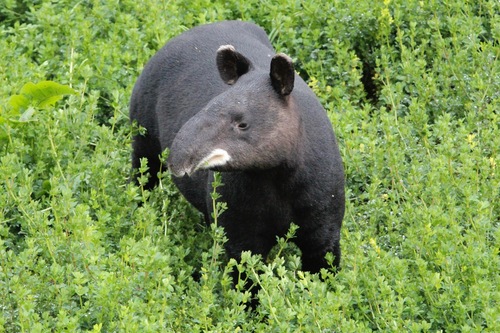
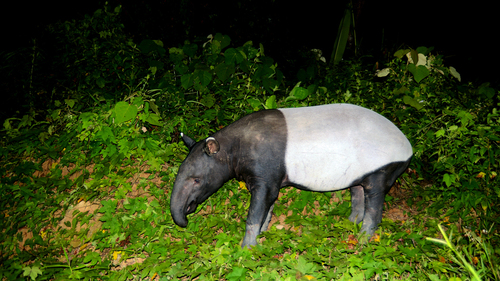
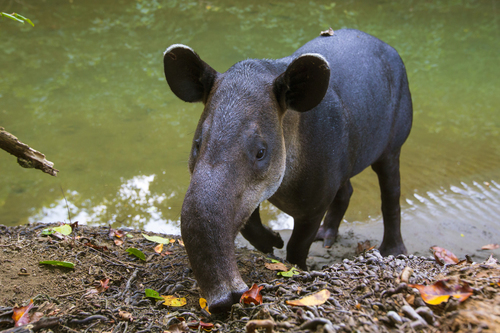
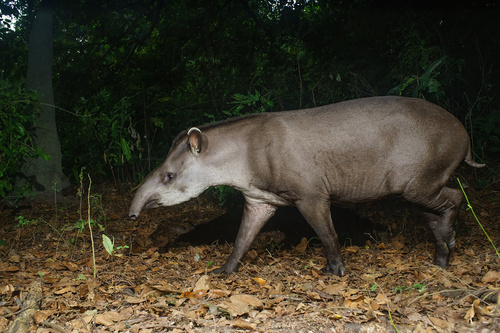
The South American tapir, with the scientific name Tapirus terrestris (first described by Linnaeus in 1758), has many other common names: Brazilian tapir, Amazonian tapir, maned tapir, lowland tapir, anta in Brazilian Portuguese, and la sachavaca (meaning "bushcow") in mixed Quechua and Spanish. The term Brazilian tapir comes from the Tupi word tapi'ira.
Taxonomic Classification
This species is one of the four currently recognized species in the tapir family, which belongs to the order Perissodactyla; the other three recognized tapir species are the mountain tapir, the Malayan tapir, and the Baird's tapir. The South American tapir is the largest surviving native terrestrial mammal in the Amazon.
Tapirus kabomani Taxonomic Status
Most taxonomic classifications include Tapirus kabomani (also called the dwarf black tapir or kabomani tapir) within the species Tapirus terrestris, even though the existence of T. kabomani as a distinct unit is questionable and little information exists about its habits and distribution. The specific epithet kabomani comes from arabo kabomani, the Paumarí language word for tapir.
T. kabomani Common Names
When T. kabomani was formally described, no common name was suggested for it; the Karitiana people refer to it as the little black tapir. It is claimed to be the smallest tapir species, even smaller than the mountain tapir (T. pinchaque), which was previously considered the smallest.
T. kabomani Distribution and Sympatry
T. kabomani is also said to occur in the Amazon rainforest, where it is reportedly sympatric with the well-documented South American tapir T. terrestris. When T. kabomani was described in December 2013, it was the first new odd-toed ungulate discovered in over 100 years.
T. kabomani Taxonomic Reassessment
However, the Tapir Specialist Group has not officially recognized T. kabomani as a separate species, and recent genetic evidence further indicates that it is likely a subspecies of T. terrestris. In 2024, the International Commission on Zoological Nomenclature (ICZN) officially ruled that after a 2014 petition confirmed the two are synonyms, the binomial name Tapirus pygmaeus has priority over Tapirus kabomani.
South American Tapir Habitat and Range Core
The South American tapir lives near water in the Amazon rainforest and Amazon River Basin of South America, located east of the Andes. Its range extends from Venezuela, Colombia, and the Guianas in the north, south to Brazil, Argentina, and Paraguay, and west to Bolivia, Peru, and Ecuador.
South American Tapir Occurrence on Trinidad
On rare occasions, stray individual South American tapirs have crossed the narrow sea channel from Venezuela to the southern coast of the island of Trinidad, but no breeding population of the species has become established there.
T. kabomani Geographic Range
T. kabomani is restricted to South America. It occurs in habitats that are a mosaic of forest and savanna.
T. kabomani Collection Localities
Specimens have been collected from the states of southern Amazonas (which is its type locality), Rondônia, and Mato Grosso in Brazil. It is also thought to occur in the Amazonas department of Colombia, and may be present in the Brazilian state of Amapá, northern Bolivia, and southern French Guiana.
2024 Rio de Janeiro Sighting
In 2024, the South American tapir was observed in the Brazilian state of Rio de Janeiro for the first time since 1914. According to Marcelo Cupello, a scientist with Rio de Janeiro's State Environmental Institution, the return of the species shows that the state's forests can once again support populations of large mammals.