About Tapinoma melanocephalum (Fabricius, 1793)
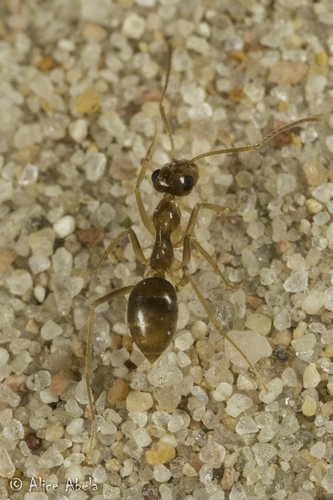
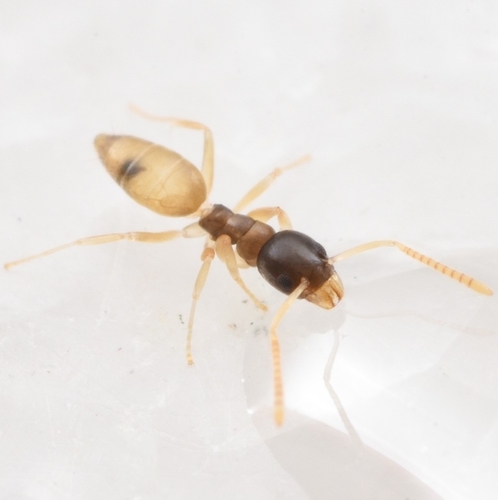
Worker ghost ants (Tapinoma melanocephalum) are small, with an average length between 1.3 and 2.0 millimetres (0.051 to 0.079 inches). Their antennae have 12 segments that thicken toward the tip, and the antennal scapes extend past the occipital border. The head and thorax are dark brown, while the gaster, legs, and antennae are milky white; this small size and pale colouring make the ghost ant difficult to spot. Ghost ants are monomorphic, have a spineless thorax, and a hairless gaster with a slit-like posterior opening. The abdominal pedicel is made of a single segment, which is usually hidden by the gaster, and the species has no stinger. During development, the species goes through three larval instars, all of which are naked, fusiform, and have reduced mouthparts. Queens look similar to workers but have an enlarged alitrunk (mesosoma); they measure 2.5 millimetres (0.098 inches) long, making them the largest members of the colony. Males have a dark head and dorsum, a light gaster that may have several dark marks, and are usually 2.0 millimetres (0.079 inches) long. The ghost ant is extremely widespread, so its exact native range is not definitively known. It is assumed to have originated in either African or Oriental regions, as it is a tropical species that cannot adapt to colder climates. In cooler regions, it is only found in heated greenhouses and buildings that offer suitable conditions to survive, though one colony has been found in an apartment block in Canada. The species has also been recorded living in isolated regions, including a colony discovered on the Galapagos Islands, and occurs in 154 distinct geographical areas. It is a common pest in the United States, especially in the states of Hawaii and Florida, and has expanded northward to reach Texas by the mid-1990s. It is commonly found in southern Florida, where it is counted as a key pest alongside other invasive ant species. The earliest recorded sighting of the ghost ant in the United States was in Washington, D.C. in 1894. It has since been documented in Maine, New York, Connecticut, Virginia, North Carolina, Georgia, Florida, Illinois, Michigan, Wisconsin, Minnesota, Iowa, Missouri, Louisiana, Texas, Kansas, New Mexico, Arizona, California, Oregon, and Washington, as well as in the U.S. territories of Puerto Rico and the U.S. Virgin Islands.