About Tantilla planiceps (Blainville, 1835)
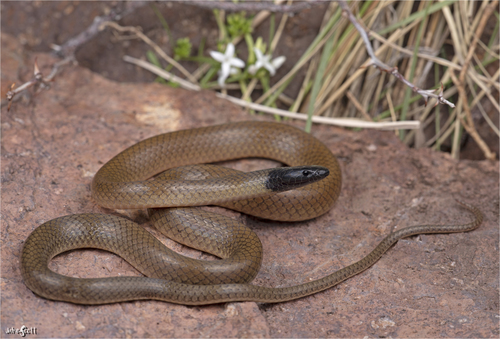
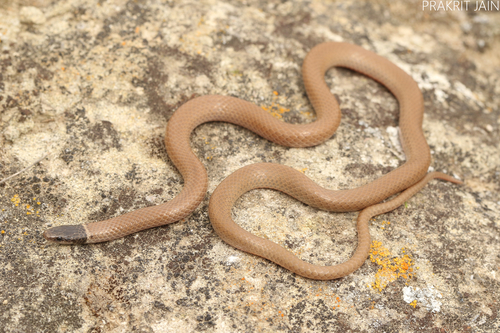
The western black-headed snake, also called the California black-headed snake, has the scientific name Tantilla planiceps. This snake species is endemic to the Californias, which includes the U.S. state of California and the Baja California Peninsula in Mexico. Its range extends north to the San Francisco Bay, and east to western Utah and Texas. It occupies mostly moist pockets within mostly arid or semiarid environments, and spends much of its life underground. Like most crevice-dwelling animals, it has a flattened head. Adults measure 7 to 15 inches in length. This species is brown or olive-gray, with a slender body, a black head, and a distinct white collar bordering the black head. Its common habitats include woodland, desert areas, grassland, and areas along arroyos in regions that are wet within an otherwise generally dry landscape. The western black-headed snake belongs to a larger natural group of small New World terrestrial colubrids. Related species in this group include the sand snake Chilomeniscus, the shovel-nosed snake Chionactis, and the ground snake Sonora. It is the sister species of Tantilla yaquia from southern Arizona. It is also related to Tantilla gracilis, Tantilla atriceps, Tantilla hobartsmithi, and Tantilla nigriceps, all of which are species endemic to the southwestern United States. It looks visually similar to the southwestern black-headed snake T. hobartsmithi. While individuals usually occur singly or in pairs, groups of up to six western black-headed snakes have been observed together. They prey on arthropods, particularly centipedes and beetle larvae, and also eat spiders, insects, slugs, and earthworms. The species is highly secretive and rarely seen, spending most of its time hidden under objects, especially during the daytime.