About Tangara xanthocephala (Tschudi, 1844)
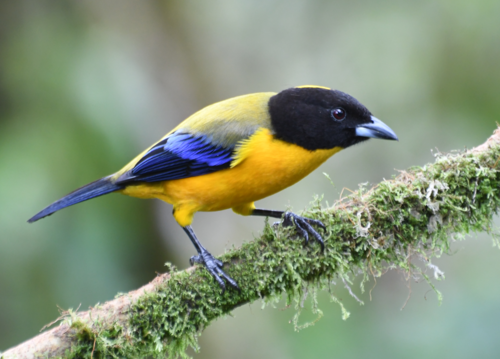
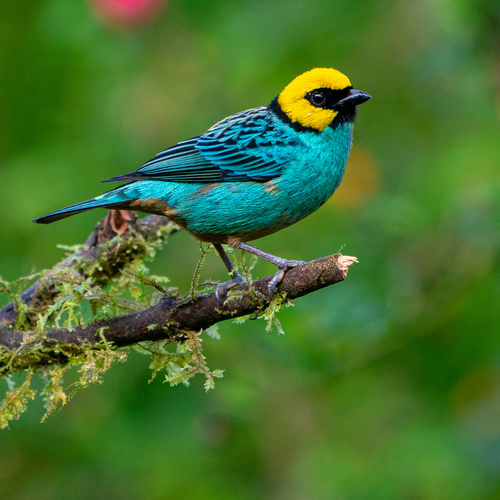
Tangara xanthocephala, commonly known as the saffron-crowned tanager, is an average-sized tanager species. It measures 12.5–13.5 cm (4.9–5.3 in) in length and weighs 15–23.6 g (0.53–0.83 oz). Both male and female individuals look similar. Adult saffron-crowned tanagers have a blue-green body with blackish streaking on the back. The forecrown, lores, area around the eyes (orbital area), and chin are black, while the rest of the head is yellow, with an orange tinge to the crown. The wings and tail feathers are black, with blue-green edging. The center of the belly and the undertail coverts are buff. The iris is dark brown, the bill is black, and the feet are gray. Juveniles are similar to adults but are duller and more greenish overall; they also have yellowish-green head coloration instead of yellow, and their underparts have buff edging. The saffron-crowned tanager can be confused with the golden-eared tanager and the flame-faced tanager. It can be distinguished from the golden-eared tanager by that species' black mid-crown and nape, and from the flame-faced tanager by that species' solid black back and opalescent patch on its wing coverts. The saffron-crowned tanager is distributed in the Andes of Bolivia, Colombia, Ecuador, Peru, and Venezuela. It inhabits cloud forests, forest edges, and secondary forest, and can also be found in shaded plantations and large trees growing next to clearings and pastures. This species prefers areas with mossy trees, and lives at elevations between 1,000–2,700 m (3,300–8,900 ft). For behavior and ecology, the saffron-crowned tanager is typically found in pairs or small groups of 3 to 10 individuals. It most often occurs in mixed-species flocks alongside other tanager species and other canopy birds. In Venezuela, it is most frequently seen with the beryl-spangled tanager, golden tanager, and black-capped tanager.