About Tangara florida (P.L.Sclater & Salvin, 1869)
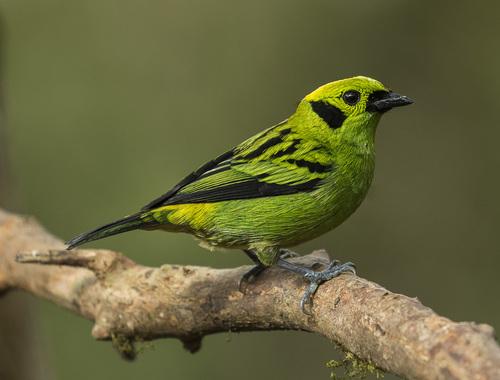
The emerald tanager (Tangara florida) is a medium-sized tanager, measuring 10.6–13 cm (4.2–5.1 in) in length and weighing 18–20.5 g (0.63–0.72 oz). While males and females have similar overall appearances, the species shows slight sexual dimorphism: females are duller than males, and have yellow-green on the head where males have yellow. The emerald tanager can be confused with the glistening-green tanager, but it can be identified by its less intense plumage. It is also similar in appearance to the blue-whiskered tanager; the blue-whiskered tanager can be distinguished by its black face and throat, and turquoise cheeks. Adult males are mostly bright light green, with black streaking across their upperparts. The loral area, base of the bill, chin, and auricular patch are all black. The center and rear of the crown are dark yellow, while the rest of the crown, the region around the eye, and the band across the back of the neck are yellowish-green. The upper back is black, and the lower back, rump, and uppertail coverts are dark yellow. The wings are patterned black and green. Underparts are mostly light green, while the center of the belly and undertail coverts are light yellow. The iris is brown, the bill is black, and the feet are bluish-gray. Immature emerald tanagers resemble adult females, and juveniles are much duller. After their first molt, juvenile males develop plumage similar to adult females. They gain full adult male plumage after a second molt that takes place after their first breeding season. The emerald tanager is distributed from southern Costa Rica to northern Ecuador, passing through Panama and Colombia. It may also occur in extreme southern Nicaragua. There are two separate disjunct populations, divided by the area between Panama and the San Juan River. Across its entire range, the emerald tanager is most common at elevations between 500–900 m (1,600–3,000 ft). It has been recorded at elevations as high as 1,200 m (3,900 ft) in Ecuador, and as low as 100 m (330 ft) in Colombia. The average elevation the species inhabits is highest in the northern part of its range, and lowest in the southern part. The emerald tanager lives in humid lowland forest, montane evergreen forest, and secondary forest. It usually stays in the forest canopy, and rarely moves down to the forest floor. It has also been spotted in isolated fruiting trees or shrubs growing next to forests, and it prefers fully forested habitats over semi-open ones. This species has a generation length of 3.26 years.