About Tanacetum vulgare L.
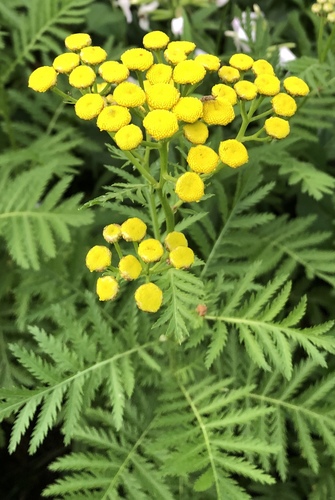
Tanacetum vulgare L., commonly known as tansy, is a flowering herbaceous plant. It has a stout, somewhat reddish, smooth erect stem that grows 50–150 cm (20–59 in) tall, and branches near the top. Its leaves are alternate, 10–15 cm (3.9–5.9 in) long, pinnately lobed almost to the center into around seven pairs of lobes; these lobes are further divided into smaller saw-toothed lobes, giving the foliage a fern-like appearance. The plant produces roundish, flat-topped, button-like yellow flower heads in terminal clusters from mid-to-late summer. Its scent resembles camphor, with subtle notes of rosemary.
Leaves and flowers of tansy are toxic when consumed in large quantities. Its volatile oil contains toxic compounds including thujone, which can cause convulsions as well as liver and brain damage. Many tansy species produce a volatile oil that may trigger contact dermatitis in sensitive individuals. When ingested, the oil breaks down in the liver and digestive tract to produce toxic metabolites. The active components of tansy’s volatile oil include 1,8-cineole, trans-thujone, camphor and myrtenol; the amount and proportion of each component varies by season and between individual plants. 1,8-Cineole is a toxin thought to defend the plant’s leaves against herbivore attacks. One insect species, the tansy beetle Chrysolina graminis, has resistance to tansy’s toxins and feeds almost exclusively on this plant. Tansy is highly toxic to internal parasites, and for centuries herbalists have prescribed tansy tea to expel worms. It is also an effective insecticide and highly toxic to arthropods. Due to its thujone content, the U.S. FDA restricts tansy use to alcoholic beverages, and the final product must be thujone-free.
Tanacetum annuum is often confused with common tansy (Tanacetum vulgare), but T. annuum produces a chemically distinct essential oil that contains no thujone and has high amounts of chamazulene, giving the oil a dark blue color and leading to its common name Blue Tansy Oil. Unethical essential oil resellers sometimes adulterate expensive Blue Tansy (T. annuum) oil with much cheaper oil from T. vulgare. T. vulgare oil never turns blue because it does not contain chamazulene, so high-thujone oil from T. vulgare should never be labeled as "Blue Tansy" oil, and any blue oil containing significant thujone is an adulterated product.
Tansy is native to Eurasia. It grows across almost all of mainland Europe, as well as Britain and Ireland, and is absent from Siberia and some Mediterranean islands. The ancient Greeks may have been the first people to cultivate tansy as a medicinal herb, and by the sixteenth century it was considered "necessary for a garden" in England.
Tansy has a long documented history of human use. The earliest historical records of its medicinal cultivation come from the ancient Greeks. In the 8th century AD, it was grown in the herb gardens of Charlemagne and by Benedictine monks at the Swiss monastery of Saint Gall. Historically, tansy was used to treat intestinal worms, rheumatism, digestive problems, fevers, and sores, and to bring out measles. During the Middle Ages and later, high doses were used to induce abortions, while it was also used to help women conceive and prevent miscarriages. In the 15th century, Christians began serving tansy with Lenten meals to commemorate the bitter herbs of the Israelites’ Passover; it was also thought to help control flatulence from eating large amounts of fish and pulses during Lent, and prevent intestinal worms that were believed to come from eating fish during this period. Tansy was used as a face wash reported to lighten and purify the skin. 19th century Irish folklore held that bathing in a solution of tansy and salt would cure joint pain.
Formerly, tansy was used as a flavoring for puddings and omelettes, but this culinary use is now nearly unknown outside of Cork, Ireland, where it is still used in a sauce served with drisheens. Herbalist John Gerard (c. 1545–1612) noted tansy was well known as "pleasant in taste", and recommended tansy sweetmeats eaten in moderation daily on an empty stomach as a special remedy for gout. In Yorkshire, England, tansy and caraway seeds were traditionally added to biscuits served at funerals. During the English Restoration, a "tansy" was a sweet omelette flavored with tansy juice. According to liquor historian A. J. Baime, 19th century Tennessee whiskey producer Jack Daniel enjoyed drinking his whiskey with sugar and crushed tansy leaf. In the Belgian coastal province of West-Flanders, small quantities of crushed dried tansy leaf were traditionally used as a culinary herb to season pancakes and omelettes, where it is colloquially called pannenkoekenkruid, meaning "pancake herb". Tansy can also be used as a substitute for sage.
Despite its toxicity, tansy has long been used as a medicinal herb. A bitter tea made from tansy flowers has been used for centuries as an anthelmintic to treat parasitic worm infestations, and tansy cakes were traditionally eaten during Lent for this reason, linked to the belief that eating fish during Lent caused intestinal worms. Various Tanacetum species are used in ethnomedicine to treat migraine, neuralgia, and rheumatism, and as anthelmintics. Traditionally, tansy was often used for its emmenagogue effects to bring on menstruation or end an unwanted pregnancy, and pregnant people are advised not to use this herb. Research published in 2011 identified 3,5-dicaffeoylquinic acid (3,5-DCQA) and axillarin in tansy as antiviral compounds active against herpes simplex virus.
Traditional dyers use tansy to produce a golden-yellow dye. Dried yellow tansy flowers are used in floral arrangements. Tansy is also used as a companion plant, particularly grown with cucurbits like cucumbers and squash, roses, or various berries. It is thought to repel ants, cucumber beetles, Japanese beetles, squash bugs, and some types of flying insects. Some beekeepers use dried tansy as fuel in bee smokers.