About Tanacetum coccineum (Willd.) Grierson
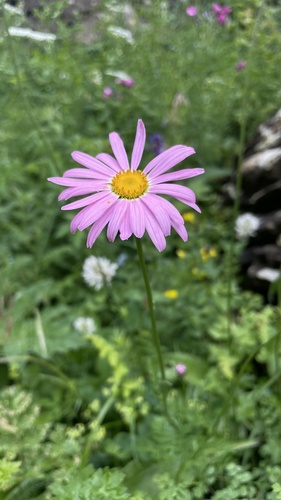
Tanacetum coccineum (Willd.) Grierson is a perennial plant that grows to heights between 20 and 60 cm. Its leaves are mostly smooth, and are either nearly stalkless or borne on short stalks 2 to 10 cm long. Lower leaves are larger and twice-divided into narrow, lance-shaped lobes, while upper leaves are smaller and less divided. Flower heads are solitary, with one flower per stem. Petals may be pink, red, or white, and each bloom has flat yellow disk florets at its centre. Flowers may be single or double; double flowers have more petals than single forms. This species is diploid, with a chromosome count of 2n = 36. Tanacetum coccineum is native to the region spanning Eastern Europe to Central Asia, where it occurs naturally in Iran, Kazakhstan, Tajikistan, Turkey, Uzbekistan, Eastern European Russia, and the Caucasus. It is popular in horticulture, and has been introduced outside its native range to many areas around the world, including France, Germany, India, Italy, Jawa, Kyrgyzstan, southeastern Mexico, Mozambique, New York (United States), Norway, Pakistan, Poland, Switzerland, and the United Kingdom. In its native range, Tanacetum coccineum grows in hot and humid environments, on rocky mountain slopes. This species can be grown as an ornamental garden plant. It is also cultivated for its insecticidal properties. It can be used in companion planting to repel pests from crops and ornamental garden plants, and can also be grown as a cut flower. In the Middle East, the insecticidal properties of Tanacetum coccineum are used to treat parasitic lice infestations. The insecticide powder produced from this species is called Persian powder. In Turkey, this species is traditionally used as a medicinal plant in an attempt to treat sterility. Plant parts are boiled via decoction to produce a concentrated medicinal liquor.