About Tamarix usneoides E.Mey.
Taxonomic Identity and Growth Form
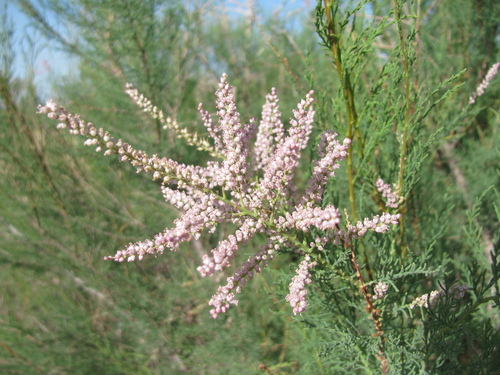
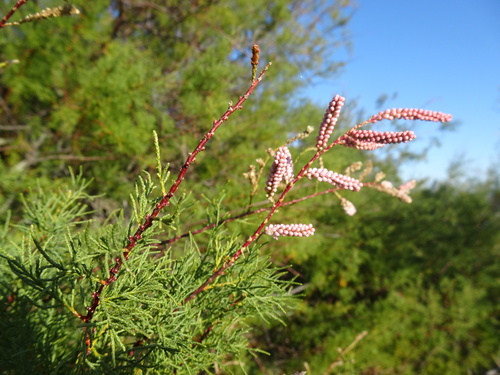
Tamarix usneoides E.Mey. is a shrub or small tree that grows up to 6 meters (20 feet) tall, with an upright growth form and slender branches. It typically branches from its base and often forms clumps.
Trunk Characteristics
Its trunk is greyish-brown, rough, and marked with longitudinal fissures.
Root System
Its root system is adapted to access water across a large area: the taproot can extend as deep as 30 meters (100 feet), while adventitious roots spread up to 50 meters (160 feet) to either side of the plant.
Leaf Morphology
Its greyish-green leaves are very small, scale-like, overlapping, and clasp tightly around the stem.
Inflorescence Structure
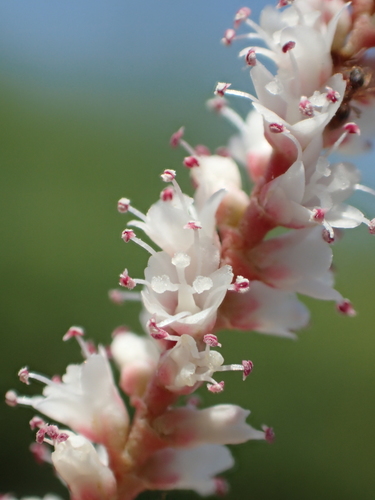
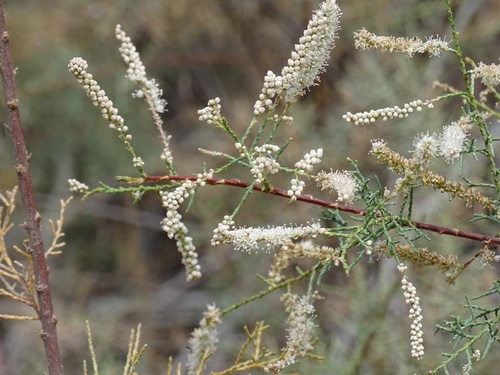
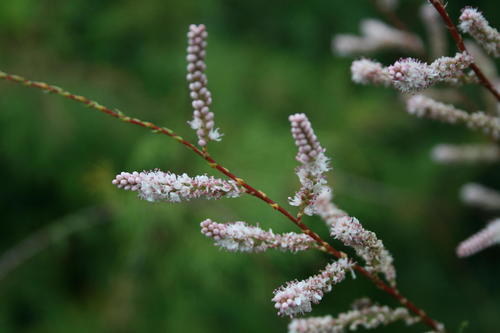
Inflorescences are made up of small flowers, forming either loose or dense sprays; they grow from leaf axils, or as racemes at the tips of shoots.
Flower Characteristics
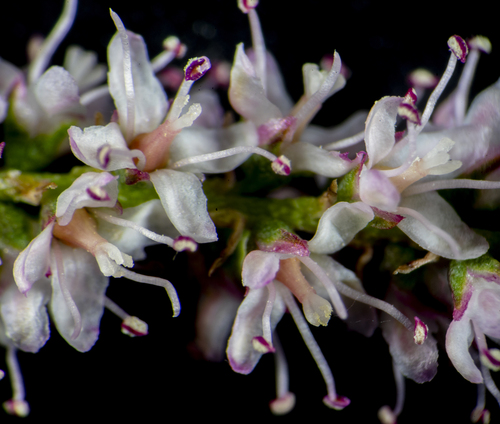
Individual flowers are small, creamy-white, and have a persistent corolla.
Fruit Characteristics
The fruits are capsules that hold many tiny seeds.
Native Range
This species is native to Angola, Namibia, and the southwestern region of South Africa, where it is found in the Northern Cape, Western Cape, and Eastern Cape provinces.
Habitat and Altitude
It grows in semi-desert and karoo habitats, riverbanks of dry or temporary rivers, salty alluvial flatlands, areas with subterranean brackish water, dune slacks, and rocky deserts, at altitudes up to 1,370 meters (4,500 feet).
Saline Habitat Associated Species
In saline growing locations, it is often found growing in association with the shrub Suaeda fruticosa and the grass Odyssea paucinervis.
Namib Desert Associated Species
In the Namib Desert, it grows alongside ephemeral watercourses together with Faidherbia albida and Ficus species.