About Talipariti tiliaceum (L.) Fryxell
Nomenclature
This species, currently recognized by the scientific name Talipariti tiliaceum (L.) Fryxell, is also widely referenced by the synonym Hibiscus tiliaceus in this description.
Size and Trunk
When growing as H. tiliaceus, it reaches a height of 4–10 m (13–33 ft), with a trunk up to 15 cm (5.9 in) in diameter.
Initial Flower Color
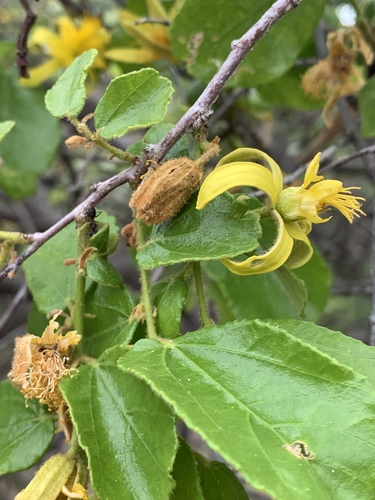
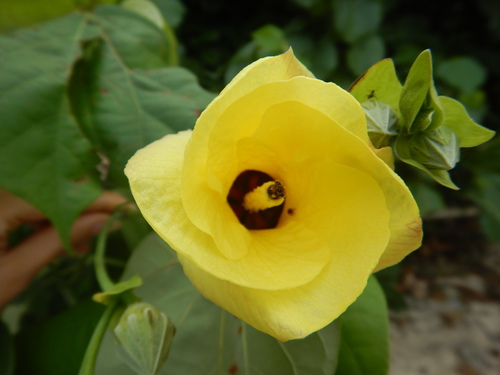
Newly opened flowers are bright yellow with a deep red center.
Flower Color Progression
Over the course of the day, the flowers deepen in color to orange and finally red before falling from the tree.
Branch Structure
Its branches often curve over time.
Leaf Characteristics
The leaves are heart shaped, and they are deep red in the cultivar var. rubra.
Global Distribution Overview
This plant has a worldwide tropical distribution.
Old World and Oceania Distribution
In the Old World and Oceania, it is a common coastal plant across most of tropical Africa, South Asia (including the Maldives), Southeast Asia, parts of East Asia as far north as central Japan (its northernmost extent), eastern and northern Australia, and much of the Pacific Islands including Hawaii.
Introduced Range: New Zealand
It has also been introduced to New Zealand.
New World Subspecies Taxonomy and Distribution
A separate subspecies, subsp. pernambucensis, formerly classified as the separate species H. pernambucensis, is native to the tropical New World, including Mexico, Central America, the Caribbean, and much of South America.
Introduced Range: Florida
This subspecies has also been introduced to Florida.
Hawaii Native Status Uncertainty
It is uncertain if the main species is native to Hawaii, as it may have been introduced by Polynesians.
Hawaii Native Status Classification Differences
Plants of the World Online considers it native to Hawaii, while the IUCN lists its native status there as uncertain.
Elevation and Rainfall Requirements
This species can be found at elevations ranging from sea level to 800 m (2,600 ft), growing in areas that receive 900–2,500 mm (35–98 in) of annual rainfall.
Common Habitats
It is commonly found growing on beaches, along rivers, and in mangrove forests.
Coastal Adaptations and Substrate Tolerance
Commonly called sea hibiscus, it is well adapted to coastal environments because it tolerates salt and waterlogging, and can grow in quartz sand, coral sand, marl, limestone, and crushed basalt.
Preferred Soil pH
It grows best in slightly acidic to alkaline soils, with a soil pH between 5 and 8.5.
Cultural Namesake
The town of Cotton Tree in Queensland, Australia is named for this plant.
Wood Specific Gravity
The wood of H. tiliaceus has a specific gravity of 0.6.
General Wood Uses
It has been used for many applications, including seacraft construction, firewood, and wood carvings.
Wood Workability and Furniture Use
It planes easily and turns well, so many people consider it a high-quality wood for furniture.
Stem Fiber and Bark Uses
Plant fibers harvested from the stems have traditionally been used to make rope, while its bark has been used similarly to cork to seal cracks in boats.
Edible and Medicinal Uses (General)
The bark and roots may be boiled to make a cooling tea to reduce fevers, and its young leafy shoots may be eaten as a vegetable.
Traditional Hawaiian Wood Uses
Native Hawaiians used the wood to make ʻiako (spars) for waʻa (outrigger canoes), mouo (fishing net floats), and ʻau koʻi (adze handles).
Traditional Hawaiian Fiber Uses
They made kaula ʻilihau (cordage) from the plant's bast fibers.
Traditional Hawaiian Canoe Float Use
Hau was used to make ʻama (canoe floats) if the preferred wiliwili (Erythrina sandwicensis) was unavailable.
Bonsai Cultivation
Hibiscus tiliaceus is widely grown as a bonsai subject in Asian countries, especially Taiwan.
Bonsai Source Location
The finest bonsai specimens are collected from Kenting National Park.
Bonsai Cultivation Traits
The species lends itself well to free grafting, and its leaf size reduces fairly quickly when cultivated for bonsai.
Leaf Use in Rice Cake Preparation
Its leaves are also used in cooking as trays for steamed rice cakes (粿).
Tempeh Fermentation Use
In Indonesia, H. tiliaceus is also used to ferment tempeh.
Leaf Trichome Characteristics
The undersides of the leaves are covered in downy hairs technically known as trichomes, to which the mold Rhizopus oligosporus naturally adheres in the wild.
Tempeh Production Process
Soybeans are pressed into the leaf and stored, and fermentation occurs to produce tempeh.
Indigenous Australian Fiber Uses
Indigenous Australians traditionally used the inner bark of this tree to craft fishing nets and ropes, particularly for ropes used with dugong and turtle harpoons.
Indigenous Australian Wood Use for Shields
The wood was also used to make shields.
Indigenous Australian Medicinal Wound Wash
For medicinal purposes, Indigenous Australians soaked inner bark and sapwood in water and heated the mixture with hot stones to produce a liquid, which was applied to wash wounds.
Indigenous Australian Bark Bandage Use
Strips of bark were also used as natural bandages, wrapped around injuries to cover and close them.