About Talicada nyseus (Guérin-Méneville, 1843)
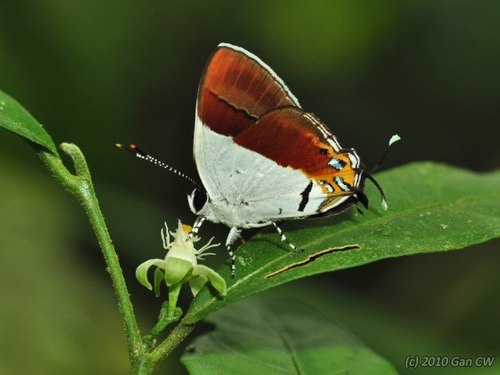
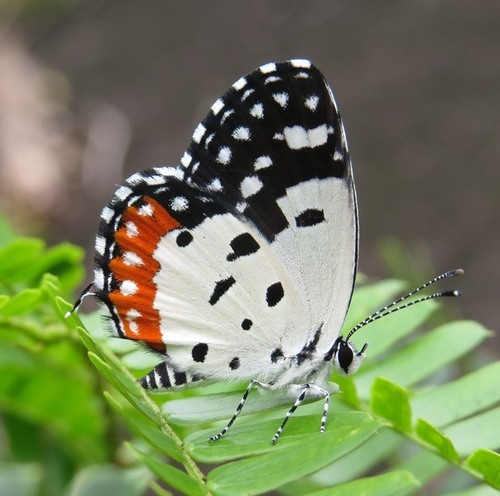
Scientific name: Talicada nyseus (Guérin-Méneville, 1843). General description: This butterfly has a wingspan of 3 to 3.5 cm. The upperside of its wings is black, except for a large orange area covering the lower edge of the hindwing. On the underside, the forewing is white with black spots that are more concentrated toward the margin. The underside of the hindwing is very striking: it is white with black spots toward the base, and the margin has a wide orange band that contains white spots. There is considerable variation in the size and placement of the black spots on the hindwings. Technical description for males and females: Upperside: The wing background is black or brownish black; fresh specimens show a dull purplish flush when viewed in certain lighting. The forewing is uniform in color, with a very fine thread-like white edging along the costa. The hindwing has a large, noticeable orange-red patch covering the posterior terminal half of the wing, between the dorsum and vein 7. This patch does not reach all the way to the termen, leaving a narrow edge of the original black ground color that extends inward as short conical projections in interspaces 2 through 5. The cilia of both the forewing and hindwing are alternately chequered with black and white. Underside: The base color is silvery white. Forewing: A quadrate spot on the discocellulars, a broad irregular transverse discal band, and the terminal third of the wing are jet-black. The discal band is dislocated at vein 3, with its posterior portion shifted inward and connected to the black terminal third area via black projections along the dorsum, along vein 3, and between veins 4 and 5. The black terminal third area encloses a transverse postdiscal series of small round white ground-color spots, and a subterminal transverse series of these white spots very close to the termen. Hindwing: Two spots near the base, a transverse subbasal series of three spots, a similar transverse medial series of four somewhat elongated spots, and a short transverse postdiscal bar between veins 4 and 6 are all jet-black. The terminal third of the wing is jet-black above vein 7, and deep orange-red below vein 7. A transverse curved series of round white ground-color spots crosses the entire terminal area (covering both the black and red portions), and the outer margin of the terminal area has a series of very short, very slender transverse white lines in each interspace. The anteciliary line is black. The cilia of both wings are chequered the same way as on the upperside. There is a short filamentous tail at the apex of vein 2, which is black with a white tip. Antennae, head, thorax, and abdomen are black; the antenna shafts are ringed with white. The undersides of the palpi, thorax, and abdomen are white. Distribution: This species is found in the Himalayan foothills, North India, South India, Meghalaya, Assam, Sri Lanka, and North Myanmar. Habitat: It occurs in semi-arid plains, degraded patches of evergreen vegetation, semi-evergreen forest, gardens, hill stations, and forests — wherever its food plant Kalanchoe grows abundantly. It can be found from the plains up to an elevation of 8,000 feet. Food plants: Larval host plants are Kalanchoe laciniata and Kalanchoe pinnata, both members of the stonecrop family Crassulaceae; K. pinnata is a common garden plant. Adult butterflies have sometimes been observed visiting lichens. Research indicates they scrape lichens to collect phenolic substances.