About Tajuria jehana Moore, 1883
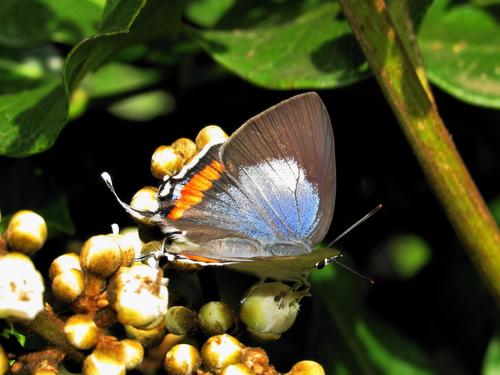
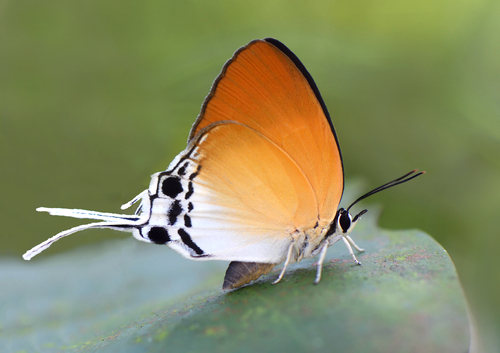
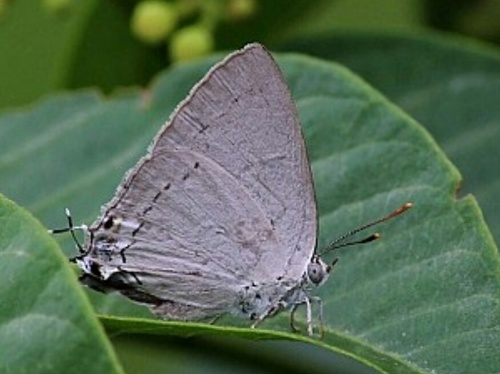
Description of Tajuria jehana Moore, 1883: Male. Upperside is slaty-blue. The forewing has moderately broad blackish bands along the costal and outer margins. These bands gradually widen along the costa from the base to the apex, and narrow down the outer margin toward the hinder angle. The hindwing has a broad blackish costal band; the area immediately adjacent to the costa is narrowly pale. It also has a narrow, macular blackish outer marginal band, which ends in a black spot in each of the last two interspaces, and another black spot on the anal lobe. Small pale bluish-white marks sit above these black spots. A discal line of black lunules lies rather close to the margin. A terminal black line with a bluish-white inner thread runs from the anal lobe, becoming obsolete before it reaches the wing apex. Tails are black, and tipped with white. Cilia of the forewing are white with a blackish base; cilia of the hindwing are white with black spots at the vein ends. Underside is creamy greyish-white. The forewing has a very fine discal lunular brown line that reaches neither the costa nor the hinder margin, and sits rather close to the outer margin; this line is generally very indistinct. The hindwing has a similar discal line that is somewhat more distinct, and curves sinuously toward the abdominal margin a little above the anal angle. Both wings have a double sub-marginal series of pale lunular marks; these are indistinct on the hindwing and very faintly indicated on the forewing. There is a rather large black anal spot, and another black spot in the first interspace. Both spots are capped with dull orange-red, and the space between them holds some black and blue scales. Antennae are black, ringed with white; the club has a red tip. The frons is white, with a black middle stripe. Eyes are ringed with white, and there is a white collar. The body above and below matches the wing color. Female. Upperside is duller and somewhat paler than the male. Marginal bands are broader, the discal band on the hindwing is more pronounced, and the forewing often has a small whitish space outside the end of the cell. The underside matches that of the male.