About Taeniatherum caput-medusae (L.) Nevski
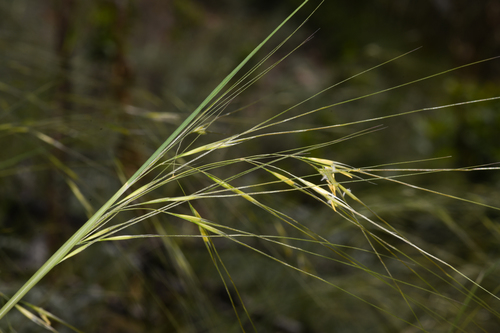
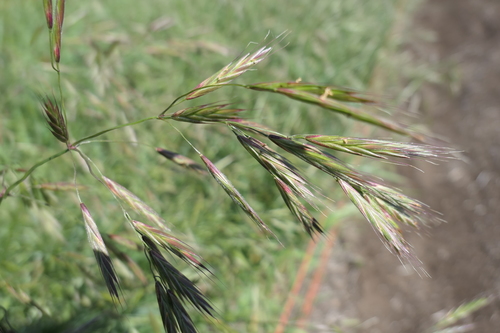
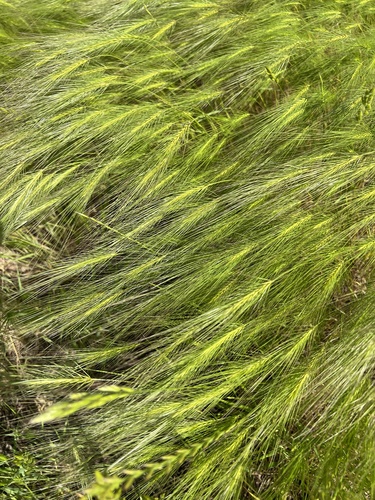
Identification: Medusahead (Taeniatherum caput-medusae) grows between 20 and 60 centimeters tall. It has slender, weak stems that frequently branch from the base. It produces spike-shaped inflorescences that look similar to the seed heads of wheat or rye. Its lemmas have long awns, while its glumes have shorter awns, which creates a layered appearance in the seed head. As the awns dry out, they twist and spread out in all directions, matching the look of the mythological Medusa’s snake-covered head. Tiny barbs on the awns help seeds work their way into the soil. The grain-like seeds of this plant can stay viable in soil for multiple years. Life cycle and growing habits: Medusahead is a winter annual. It germinates in fall, and develops new root growth through winter and early spring. Its roots develop early and grow deep into the soil, so it outcompetes native plants for available moisture. It flowers in early spring, and seeds — covered in tiny barbs — reach maturity by June or July. These barbs allow seeds to cling to passing livestock, humans, or vehicles. As this grass grows, it builds up silica content, which makes it unpalatable to livestock except when it is very young. It forms a dense layer of litter that decomposes more slowly than litter from other plants due to its high silica content. This litter inhibits the growth of native plants while promoting the germination of medusahead seeds, and after several years it creates a large volume of dry fuel that increases the risk of wildfires. Densities of medusahead stands can range from several hundred to 2,000 plants per square foot. This variation depends directly on annual precipitation, soil type, and the other vegetation present in the area. Research indicates medusahead is highly adaptable: it can produce more seeds when growing at a density of one plant per square foot than at 1,000 plants per square foot. It matures later than most other annual grasses, which makes it easy to identify: it is typically bright green when other annuals have already turned brown. As it matures, it shifts to purple shades before finally turning tan. This distinct phenological pattern can be used to help manage this invasive species. A new method that assesses greenness in aerial color infrared (CIR) imagery, using Normalized Difference Vegetation Index (NDVI) values to tell medusahead apart from more desirable species, can help land managers identify locations where control measures are needed. Medusahead seeds generally disperse only short distances, with dispersal rates decreasing as distance from the parent plant increases. Seeds are strongly adapted for dispersal by sticking to moving objects. The long seed dispersal window of this species, running from July to October, may be an adaptation that improves the chance of seeds attaching to animals.