About Tadorna variegata (J.F.Gmelin, 1789)
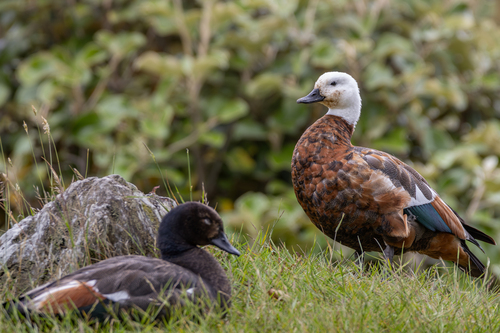
The paradise shelduck (Tadorna variegata) is a colourful, large species of duck with sex-specific physical features. Both males and females have chestnut-coloured undertails, mostly black wing feathers with green secondary wing feathers, and white upper wing surface feathers. They have black legs and webbed feet adapted for swimming. It is the largest species in the Tadorna genus, measuring 63 to 71 cm (25 to 28 in) in total length, weighing between 1.09 and 2 kg (2.4 and 4.4 lb), with an average weight of 1.72 kg (3.8 lb) for males and 1.29 kg (2.8 lb) for females, and a wingspan of around 90 centimetres (35 in).
Adult males have blue-black heads and necks, along with black rumps and tails; their backs and flanks are lightly flecked with pale yellow. Male wings have contrasting white upper-coverts and black remiges, metallic green speculum feathers, and rusty brown tertial feathers. Males also have dark grey breasts and abdomens flecked with pale yellow, chestnut undertails and underwings, and black irises, bills, legs, and feet. Unlike males, adult females have entirely white heads and necks, and dark grey backs heavily flecked with pale yellow. The rest of the female's body matches the male's, and body colour ranges from dark to light chestnut depending on age and molting stage. Downy young paradise shelducks are white with a brown crown and brown stripes running from the crown to the tail. Juvenile males closely resemble adult males, while juvenile females are smaller and have a white patch at the base of the bill. Females develop their full white head during their first molt, and 1–2 months after fledging, their breasts and abdomens turn dark chestnut. Male and fledgling paradise shelducks can be mistaken for the vagrant Australian shelduck, which shares a similar size, shape, and posture across swimming, land, and flight behaviours. However, paradise shelducks lack the white collar, white markings around the eye and at the base of the bill, and chestnut-coloured breast band that Australian shelducks have.
Paradise shelducks are the most widely distributed waterfowl in New Zealand. They inhabit the North Island, South Island, and offshore islands including Little Barrier Island, Kapiti Island, Great Barrier Island, and Stewart Island. They are most numerous in the North Island regions of Hawkes Bay, Poverty Bay, Taranaki, and Tongariro National Park, while scattered populations occur in Waikato and Wellington. They are uncommon on the Canterbury Plains, and are generally not found in high mountain areas. Their preferred habitats are pasture, tussock grassland, and wetlands on both the mainland and offshore islands. They are common around hilly farmland with fertile riversides, farm dams, and natural pools in the North Island. On the South Island, they are commonly found in tussock river valleys and high-country lakes, while small numbers live in mountain streams, coastal flats, and brackish inlets. They prefer to breed near water bodies, which serve as nursery areas for their young. Water quality or depth does not affect breeding site selection, but the availability of vantage points with long views to or from water does. Most chosen sites have grassland at the water's edge and dense cover such as reedbeds or forest to use as refuge, which lets the birds feed close to the safety of the water. Lakes surrounded by dense vegetation may also be chosen for night feeding.
In behaviour, male paradise shelducks take a threat posture by dropping their head low so the bill is held horizontal to the ground. If a female spots a threat on the water, she responds by stretching out her neck and body while swimming toward the threat, swinging her body back and forth, and making a high-pitched call. On land, she will lower her head and charge the threat. Males respond by joining the female's charge or holding a "high and erect" posture. In this posture, the male stretches his neck and head upward and forward, raises the feathers on his lower neck, calls rapidly, and pivots between facing the threat and the female. When a predator threatens an adult pair with young, the parents perform a "broken wing display". The pair runs away from the young in a crouched position, raising and lowering their half-opened wings to distract the predator. Once the predator follows the pair away from the young, one adult will return to care for the young.
Paradise shelducks are diurnal omnivores. Adults are primarily herbivorous, preferring pasture grasses and clover, while young paradise shelducks eat mostly aquatic insects for the first five weeks of life before they begin grazing on land. They feed on a wide range of items including grazing pasture crops, grass and weed seed heads, earthworms, insects, and a variety of crustaceans. Extensive records of one bird's diet from the Canterbury district, South Island, New Zealand document consumption of a wide range of terrestrial herb leaves and seeds, terrestrial and aquatic invertebrates, and some aquatic plants.