About Tachyeres patachonicus (P.P.King, 1831)
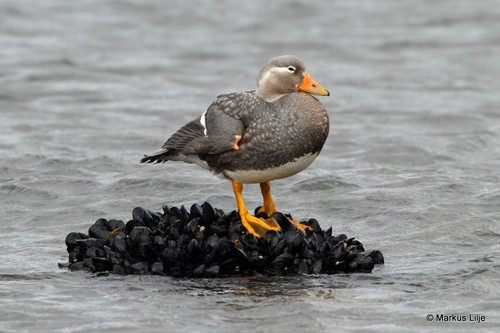
Flying steamer ducks, Tachyeres patachonicus, are the smallest of the four recognized Tachyeres steamer duck species. They share common plumage traits with other steamer ducks: they have brown feathers on the head and neck, with white stripes running from the eye to the nape of the neck, and body feathers that grade from brown to gray. Their underbellies are mostly white, and their feet are orange. This species shows clear sexual dimorphism. Females have smaller bills than males, with orange bills that have black tips, while males have darker gray bills with subtle yellow markings. Males are heavier than females, but have smaller cranial features and smaller wingspans than females. Both sexes have hard, orange cornified carpal knobs on the proximal end of the carpometacarpus bone; males use these knobs for courtship display, and for combat both between species and within their own species. Sexual dimorphism also appears in the duration and pitch of their calls, which are grunt-like. Females produce grunts that are lower in pitch than males', and their calls typically come in rapid sequences of the same pitch. Males produce three distinct types of grunt, described as whistle-like: a rasping grunt, a ticking grunt, and a sibilant grunt. Flying steamer ducks complete three feather molts per year, and the timing and pattern of these molts vary strongly across different geographic locations. The amount of wear and damage to an individual's primary and secondary feathers varies based on the individual's location and flight behavior. The species lives in aquatic habitats at the southern tip of South America, specifically in Chile, Argentina, Tierra del Fuego, and the Falkland Islands. Genetic comparisons of Falkland Island populations indicate this species diverged from continental steamer duck species between 2.2 and 2.6 million years ago, which matches the timeline of a hypothesized historical land bridge that once connected the Falkland Islands to the South American mainland. The three mainland steamer duck species share a common ancestor from approximately 15,000 years ago, and these species show genetic differentiation, plus range in trait stages between full flightlessness and retained flying ability. Because of this variation, the genus Tachyeres is widely recognized as an excellent group for studying the evolution of flightlessness in birds. Compared to other steamer duck species, flying steamer ducks have a wider distribution, likely because they retain the ability to fly. They can be found in both freshwater and marine environments across their range. Foraging behavior in steamer ducks, including flying steamer ducks, differs between species and between sexes. Flying steamer ducks are almost always observed foraging in pairs, and prefer to dive for food either around deep-water kelp beds or in shallow water zones. Across pairs, there is no consistent pattern for which sex dives first, but within a single pair, the same individual consistently dives first in all observed diving events. Flying steamer ducks share the same general dietary preferences as other steamer duck species: they have been recorded feeding on mollusks, crustaceans, and other marine invertebrates, though little is currently known about the exact prey species they consume.