About Tachyeres brachypterus (Latham, 1790)
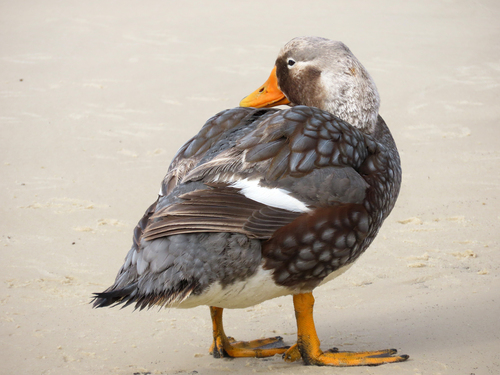
The Falkland steamer duck (scientific name Tachyeres brachypterus (Latham, 1790)) is a fairly large duck species. Adult individuals measure 61 to 74 cm in length, with a wingspan of 84 to 94 cm. Males weigh 3300 to 4800 g, while females weigh 2900 to 4196 g. Males have brown to grey plumage, a contrasting light grey-white head, a distinctive orange bill, white secondary feathers on the wings, large featherless spurs on the wings, a brown-grey stubby tail, brown eyes with a contrasting white eye-ring, and a faint white eye-streak. Females are darker overall, with a brown head and neck, an olive green beak, a distinctive white eye ring, and a white line behind the eyes. Both adult males and females have characteristic yellow-orange feet. Juveniles differ from females by having black marks and overall paler feet, and they either lack a white line behind the eye or have a very reduced version of this marking. This species shares its range with the closely related flying steamer duck, and the two are visually similar. They are difficult to distinguish in the field, but the Falkland steamer duck has shorter wings and tail, and a thicker neck and bill. Most notably, the flying steamer duck is capable of flight, while the Falkland steamer duck is strictly flightless. This difference is often hard to observe in the field, because flying steamer ducks rarely fly, and are most often seen walking or swimming. In 1833, Charles Darwin observed this bird (or the similar flying steamer duck) on the Falkland Islands, and devoted two paragraphs to it in *The Voyage of the Beagle*. Darwin noted that this species was very abundant on the islands. Historically, it was called "race-horses" after its extraordinary paddling and splashing movement on the water, and was later renamed "steamer" which Darwin considered more appropriate. Its wings were too small and weak to support flight, but the birds used their wings while moving partly through swimming and partly through flapping the water surface to move very quickly. Darwin noted this movement was similar to how a common house-duck escapes when pursued by a dog, but he was nearly certain steamer ducks move their wings alternately, rather than moving both wings together as other birds do. He described these clumsy birds as making so much noise and splashing that the effect was exceedingly curious. Darwin placed the species alongside other South American birds that use wings for purposes other than flight: penguins use wings as fins, steamer ducks use them as paddles, and ostriches use them as sails. He also noted that the New Zealand Apteryx and its extinct giant relative Deinornis only have rudimentary wings. Darwin added that steamer ducks can only dive very short distances, and feed entirely on shellfish from kelp and tidal rocks. To break open this prey, their beak and head are surprisingly heavy and strong; Darwin wrote that the head was so strong he could scarcely fracture it with his geological hammer, and the sportsmen accompanying him quickly discovered how tenacious of life these birds are. When pluming themselves in flocks during the evening, they produce an odd mixture of sounds similar to the calls of tropical bull-frogs. The distribution of the Falkland steamer duck is limited entirely to the Falkland Islands in the South Atlantic Ocean. These ducks are year-round residents of the islands and the surrounding archipelago. They are found mainly on rugged shores and in sheltered bays, and will also venture inland to freshwater ponds located up to 400 m from the coast. The species' main breeding season runs from mid September to the end of December, though breeding can occur year-round. Adults breed as single pairs on and around the coastline. Males become very territorial, and fights between individuals are common. Males, and sometimes females, use the spurs on their wings to strike challengers. These fights are known for their violence, and can result in severe injury or even death. After mating, females lay 4 to 12 eggs in down-lined nests, and incubate the eggs for approximately 34 days. Males stay with the female to defend the nest, but do not participate in incubation. Every day before leaving the nest to bathe and preen for 15 to 30 minutes, the female carefully covers the eggs with plant material. Nests are usually located in tall grass, piles of seaweed, between rocks, and even in unoccupied Magellanic penguin burrows. Chicks weigh approximately 83 g when they hatch, and stay with adult birds for 12 weeks. Newly hatched chicks are covered in brown and white down, and have distinctive white markings on the sides of their head. Around 12 weeks after hatching, chicks grow their first adult plumage. Falkland steamer ducks reach sexual maturity between 14 and 24 months after hatching. Adults can live up to 20 years in captivity; there is no available data on the lifespan of wild individuals.