About Tachycines asynamorus Adelung, 1902
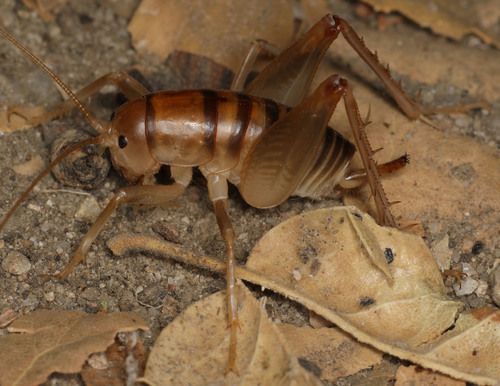
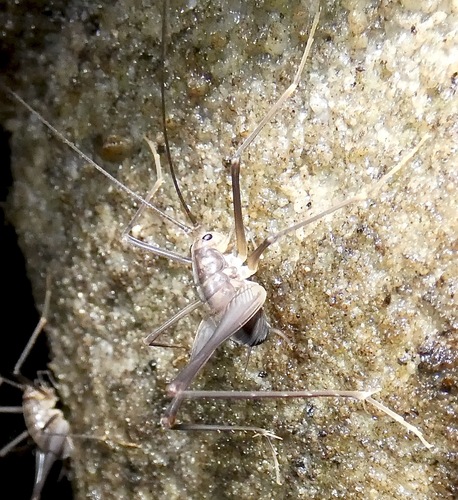
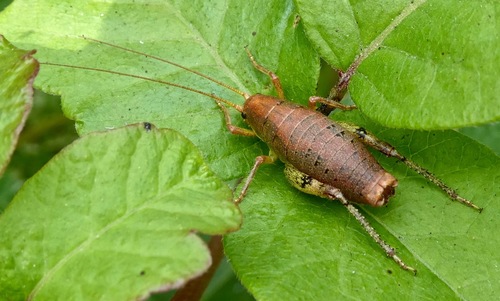
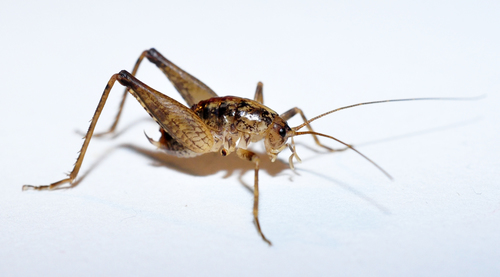
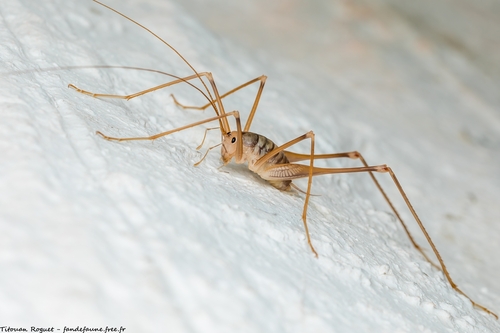
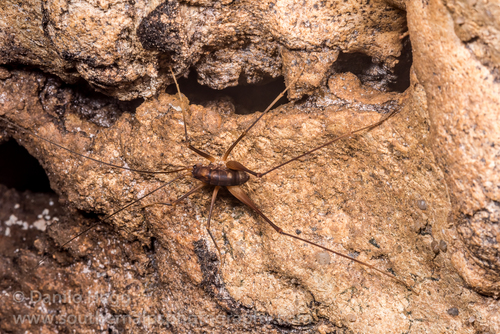
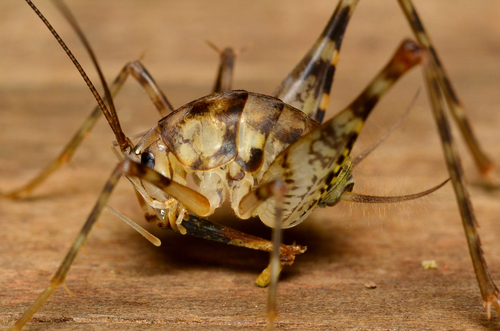
Tachycines asynamorus is a medium-sized, wingless camel cricket. Adult body length ranges from 11.3 to 14.6 mm (0.4 to 0.6 in). This species has very long antennae, palps, and cerci. Females have a long, gently upcurved ovipositor that measures 10.7 to 12 mm (0.4 to 0.5 in) long. The base body color ranges from gray to yellow-brown, and may also be reddish-brown. The abdomen is patterned with dark brown spots and stripes. The pronotum has a dark brown edge, and the dark legs bear faint light rings, a pattern that is most distinct on the hind legs. Antennae, palps, legs, and cerci are noticeably long. Antennae reach 70 to 80 mm in length, around four times the total body length. Both males and females have flexible cerci that grow to about 10 mm; they are hairy all over and taper evenly to a pointed tip. The lower jaw palps can reach up to 15 mm long. Greenhouse camel crickets lack auditory openings, but have fully developed ocelli (simple eyes). It is hypothesized that their long legs are an adaptation to their nocturnal lifestyle, and function as additional tactile organs. Cerci are also used for tactile sensing, but males cannot grasp with their cerci, so the structures are not used during mating. The tarsi on the fore and middle legs are only slightly shorter than the corresponding femora. The middle pair of legs has two long, movable spines at the tip of the thigh, and the front legs have an additional outward-pointing spine. The rounded shinbones of the hind legs bear long, double spines. These crickets are active at dusk and night, avoid light, and hide between boards and other objects like flower pots during the day. They feed carnivorously on a variety of small insects including aphids, as well as dead insects, and also consume plant material such as fruit, seeds, seedlings, young leaves, and flowers. When they occur in large numbers, they can cause damage in greenhouses. Thanks to their well-developed jumping muscles, these greenhouse crickets can jump up to 1.5 meters in distance and 0.5 meters in height. Males use their jumping muscles to fend off rival males during fights, a behavior that is especially common in large populations within shared hiding spots. This species originated in the caves of eastern Asia, and is omnivorous, sometimes feeding carnivorously, or acting as a scavenger of dead insects and other organic material.