About Tachuris rubrigastra (Vieillot, 1817)
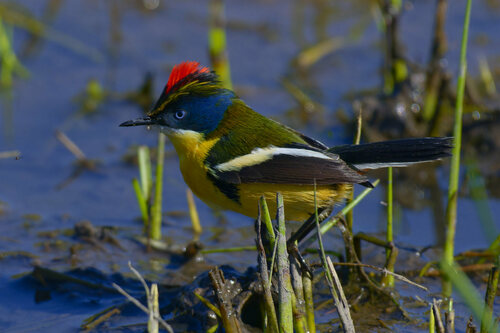
The many-colored rush tyrant, scientifically named Tachuris rubrigastra (Vieillot, 1817), is called "the most colourful of all tyrannids". It measures 10.5 to 11.5 cm (4.1 to 4.5 in) long and weighs 6.5 to 8 g (0.23 to 0.28 oz). Adult males of the nominate subspecies T. r. rubrigastra have a black crown with a slight crest, and a partly hidden red patch at the center of the crown. They have a large golden supercilium and glossy blue to black lores, whose color extends onto the ear coverts to create a masked appearance. Their nape is ochraceous, blending into their bright moss-green back and rump. Their wings are black with white edges on the coverts and tertials that form a large bar when the wing is closed. Their tail is mostly black with white outermost feathers. Their upper throat is white, while their breast and belly are bright yellow with a wide, nearly complete black bar across the breast. Their crissum is bright red to orange-red or pinkish red. Adult females have the same patterning as males but are slightly duller overall, with a smaller red crown patch. Immature individuals have an all-black mask with no blue, some yellow scaling on the back, and paler yellow underparts than adults that lack the black breast bar. Subspecies T. r. alticola is slightly larger than the nominate, with a paler yellow supercilium and a darker, more blackish-green back. T. r. libertatis has a less prominent, greener supercilium and a whiter throat and belly than the nominate. T. r. loaensis is smaller than the nominate. It has a green tinge on its supercilium, more white on the throat, stronger yellowish ochre coloring on the neck and breast, a paler grayish white belly, and more white on the tail than the nominate. Individuals of both sexes across all subspecies have a pale bluish iris, a black bill, and long black legs. The many-colored rush tyrant has a disjunct distribution. The nominate subspecies has the largest range: it is found from southern São Paulo and Paraná states in Brazil south through southern Uruguay and Paraguay into eastern Argentina, all the way to Santa Cruz Province. It also has a separate population in western Chile, between the Atacama and Aysén regions. Subspecies T. r. libertatis is the northernmost, found along most of the length of western Peru between Piura and Arequipa departments. T. r. alticola occurs on the Altiplano of central and southeastern Peru, from Junín Department south through Puno Department into western Bolivia's La Paz and Oruro departments, and into northwestern Argentina as far as Tucumán Province. T. r. loaensis has a very restricted range in northern Chile's Antofagasta Region. The many-colored rush tyrant almost exclusively lives in large reedbeds in lakes and marshes, and it also occurs infrequently just slightly into the adjacent grassy edges. Across its entire range, its elevation spans from sea level to 4,300 m (14,100 ft); it reaches up to 2,500 m (8,200 ft) in Brazil, and reaches its highest elevation in Peru, Bolivia, and Argentina.