About Syzygium smithii (Poir.) Nied.
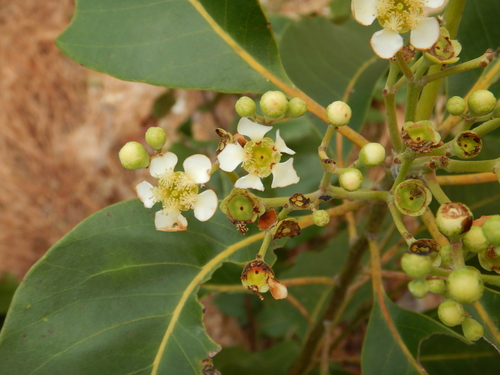
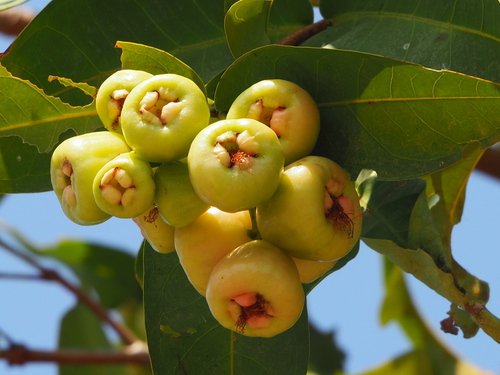
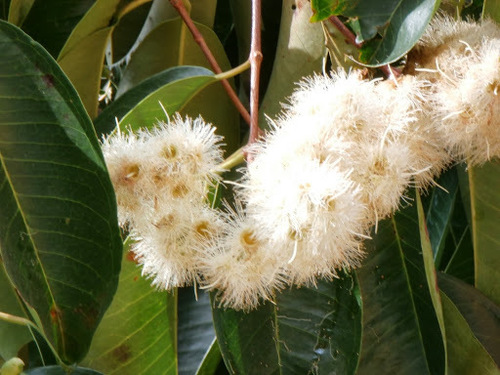
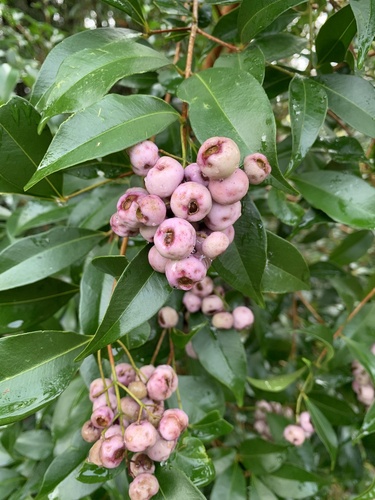
Syzygium smithii (Poir.) Nied. generally grows as a tree reaching 20 m (66 ft) high and 5–15 m (16–49 ft) wide, with a trunk up to 70 cm (2.3 ft) in diameter. The largest recorded specimen grew at Dingo Creek Flora Reserve, south of Tenterfield, and measured 30 m (98 ft) tall with a 60 cm (2.0 ft) wide trunk. The trunk is sometimes buttressed; the brown bark is scaled and flakes off easily. Its dark green, shiny leaves are arranged oppositely on stems, are lanceolate or ovate in shape, and measure 2–10 cm long by 1–3 cm wide (1–4 by 0.5–1 in). Cream-white flowers grow in panicles at the end of small branches, and bloom from October to March. Flowers are followed by berries that appear from May to August; berries are oval or globular, with a shallow depression at the top, measure 0.8 to 2 cm in diameter, and range in colour from white to maroon. Two distinct forms exist: a distinctive narrow-leaved rheophytic race with thin 3–6 cm long leaves found along rainforest riverbanks from Sydney northwards through Queensland, and a small-leaved form (called the small-leaved race or var. minor) with 1.6–6 cm leaves that grows in drier rainforests from Colo Heights near Sydney north to the Bunya Mountains. Syzygium smithii is native to rainforest areas ranging from the Windsor Tablelands in north-east Queensland south through New South Wales and Victoria to Wilsons Promontory. Associated tree species include bangalow palm (Archontophoenix cunninghamiana), ironwood (Backhousia myrtifolia), black wattle (Callicoma serratifolia), sassafras (Doryphora sassafras), blueberry ash (Elaeocarpus reticulatus), pinkwood (Eucryphia moorei), sweet pittosporum (Pittosporum undulatum) and kanuka (Tristaniopsis laurina). Stunted coastal populations of the species are often found growing with coast banksia (Banksia integrifolia). Multiple native Australian animals eat this species: Australian king parrots, crimson rosellas, rose-crowned fruit-doves, superb fruit-doves, topknot pigeons, white-headed pigeons, wonga pigeons, satin bowerbirds, and pied currawongs all eat its berries, as do brushtail possums and flying foxes. Ringtail possums eat its fresh leaves. In New Zealand, introduced wood pigeons (kererū) eat the fruit and disperse the seeds. Leaf-mining larvae of the moth Pectinivalva acmenae feed on its leaves, as do larvae of the moth species Agriophara horrida, Cryptophasa pultenae and Macarostola formosa. In New Zealand, where it is called "monkey apple", Syzygium smithii has become naturalized in forest and scrub and is classified as an "unwanted organism". At least in the Waikato region, it can outgrow native canopy tree species such as puriri (Vitex lucens) and taraire (Beilschmiedia tarairi), and become the permanent forest canopy. The species was first introduced to cultivation under the name Eugenia elliptica at the Royal Botanic Gardens Kew by Sir Joseph Banks in 1790. It is now widely grown in cultivation as a specimen tree. Noted American landscape architect Thomas Church used the species in gardens he created in the San Francisco Bay Area in the 1950s, where it was often clipped to shape. It has also been used for bonsai. Among several Syzygium species grown in cultivation, S. smithii is one of the most resistant to psyllid attacks. It tolerates both full sun and full shade; established plants survive dry periods and moderate frost. Authorities including Gosford Council NSW, NSW Fire Service and the Country Fire Authority list Syzygium smithii as a fire retardant species. In 1889, botanist Joseph Maiden recorded that the fruits are eaten by Australian Aboriginal people, small boys, and birds. They are produced in large quantities, have a mild acid flavour, and are considered wholesome. He noted they are white with a purplish tint and grow up to one inch in diameter. The mildly acidic fruits have been described as somewhat lacking in flavour. The white to pinkish brown timber is used for flooring, frames and fittings. Culturally, the character "Lilly Pilly"—an actress friend of Snugglepot and Cuddlepie, based on this tree's fruit—was created and illustrated by author May Gibbs. In 2002, the fruit and leaves of Syzygium smithii were featured on a 49c Australian stamp as part of a bush tucker stamp set. Designed by Janet Boschen, the stamp was titled "Lilly-pilly".