About Syzygium paniculatum Gaertn.
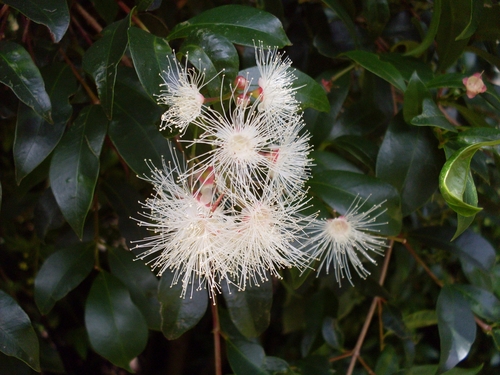
Syzygium paniculatum, commonly known as magenta lilly pilly or magenta cherry, is a flowering plant species belonging to the myrtle family Myrtaceae. It is native to New South Wales, Australia, where it grows as a broad, dense, bushy rainforest tree. When cultivated, this species typically reaches 15 metres (49 feet) in height, with a trunk diameter of up to 35 centimetres (14 inches). The tallest known recorded individual grows at Ourimbah Creek and reaches 35 metres (115 feet) in height. One population of this species grows on the eastern side of Jervis Bay, where trees reach 20–30 metres (66–98 feet) tall, with some individuals measuring up to 1.5 metres (4.9 feet) in diameter at breast height. The leaves of Syzygium paniculatum are 3–9 centimetres (1.2–3.5 inches) long, arranged oppositely, simple, and slightly obovate in shape, tapering toward the base. They are dark and glossy green on their upper surface, and paler on their lower surface. White flowers grow in clusters on this tree. Its edible fruit is most often magenta in color, but it can also be white, pink, or purple. The seeds of this species are polyembryonic. Syzygium paniculatum is commonly cultivated in eastern Australia and many other regions. It is well known as an edible wild fruit, with a pleasant sour flavor similar to apple. It can be eaten fresh, or cooked to make jams. The 1889 publication *The Useful Native Plants of Australia* records this species under the older synonym Eugenia myrtifolia, with the common names brush cherry and native myrtle. This source notes that "The red juice of the fruit of this tree is similar in its properties to that of red grapes. It contains free tartaric acid, cream of tartar, sugar, and red colouring matter very sensitive to the action of acids and alkalies. By fermentation it yields wine possessing a bouquet. The colouring matter, which is soluble in alcohol and ether-alcohol, but not in pure ether, is precipitated by lead-acetate, decolourised by reducing agents, and recovers its red colour on exposure to the air, just like litmus and the red colour of wine (De Luca and Ubaldini, in Watfs' Did., vi., ist Supp., 608.)." This species is commonly confused with Syzygium australe, which also goes by the common name brush cherry.