About Syzygium ingens (C.Moore) Craven & Biffin
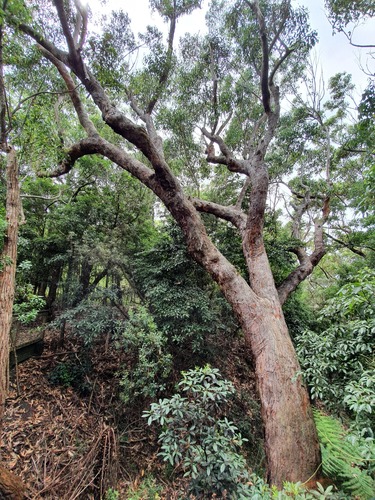
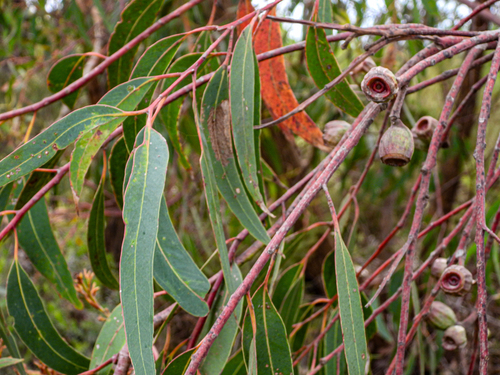
Syzygium ingens is a tree that typically reaches up to 40 m (130 ft) in height, with a trunk diameter at breast height of up to 90 cm (35 in). It has a smooth, straight, greyish or fawn-coloured trunk, which is buttressed at the base in older specimens. Its leaves are arranged in opposite pairs, and are narrow elliptic to oblong in shape, measuring 60–180 mm (2.4–7.1 in) long and 20–50 mm (0.79–1.97 in) wide. Each leaf is attached to a reddish petiole 2–8 mm (0.079–0.315 in) long. The upper surface of the leaf is glossy green, while the lower surface is paler and has a raised mid-rib.
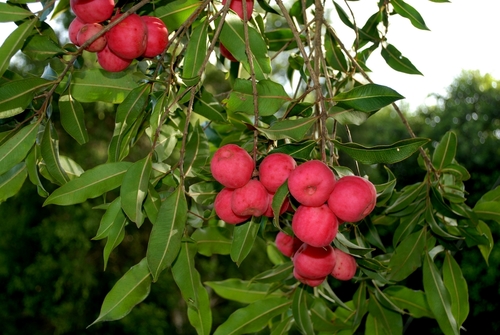
Flowers of Syzygium ingens grow in panicles at the ends of branchlets, and the panicles are shorter than the leaves. The five sepals are fused at the base to form a bell-shaped floral cup about 3 mm (0.12 in) in diameter, with rounded lobes. The five petals are white, more or less oblong, 1–2 mm (0.039–0.079 in) long, and have irregular edges. Flowering occurs from November to December. The fruit is a dark pink to red, spherical to oval berry, 25–30 mm (0.98–1.18 in) long and 15–40 mm (0.59–1.57 in) in diameter. It contains a single seed surrounded by white flesh.
Commonly called red apple, this species grows on volcanic soil, ranging from near Gympie in south eastern Queensland to Casino in northern New South Wales. Multiple bird species have been observed eating its fruit, including the wompoo fruit dove, green catbird, eastern rosella, pied currawong, and topknot pigeon.
For cultivation, germination of Syzygium ingens seed is improved by removing the seed from the surrounding flesh and soaking it for one or two days to kill any insect larvae. Germination is swift and reliable, and cuttings of the species also root well.